
The Missing Layer Between Visibility and Trust
For years, a huge amount of marketing activity has focused on visibility.
Rank higher.
Get more traffic.
Increase reach.
Generate more impressions.
Appear in more places.
And there is a logic to that. If people cannot find a business, they have very little opportunity to buy from it.
But marketing conversations often make an enormous leap from visibility to trust.
We talk about getting a business in front of more people and then immediately start discussing enquiries, conversions and sales.
As though being seen naturally leads to being trusted.
But what happens in between?
Because visibility only tells us that somebody had the opportunity to encounter a business.
It does not tell us whether they understood what they encountered.
And that may be one of the most overlooked layers in modern marketing.
The Visibility Trap
The assumption is often fairly simple.
More visibility should generate more enquiries.
Sometimes it does.
Sometimes it doesn’t.
A business can rank well in search results, appear in AI-generated answers, post consistently on social media and attract visitors to its website.
Yet enquiries remain stubbornly flat.
The immediate reaction is often to chase more visibility.
More content.
More social posts.
More SEO.
More advertising.
More traffic.
A little like setting off down the Yellow Brick Road in search of an answer, businesses can keep moving forwards looking for the next marketing activity that will solve the problem.
But sometimes, the thing they need to examine was there before the journey began.
What do people understand when they find us?
Imagine a business looking at its website analytics. Traffic has increased by 30%, but the number of enquiries has barely changed.
The obvious question appears to be:
How do we get even more people to the website?
But perhaps there is another question worth asking first.
What do people understand when they get there?
Because visibility and understanding are not the same thing.
You can put a business in front of thousands of people.
If those people still cannot quickly work out what the business does, who it helps or why it might be relevant to them, increasing the audience may simply increase the number of people experiencing the same confusion.
Visibility Is Easier to Measure Than Understanding
One reason businesses focus so heavily on visibility is that visibility is relatively easy to measure.
Rankings.
Traffic.
Impressions.
Clicks.
Reach.
Follower numbers.
These figures fit rather nicely into dashboards and reports. We can graph them, compare them with last month and discuss whether the line is going in the right direction.
Understanding is rather less cooperative.
How many people visited your website and misunderstood what you do?
How many assumed your service was not relevant to them when it actually was?
How many could name your business but would struggle to explain it to somebody else?
How many left because they could not work out what would happen if they contacted you?
There is rarely a tidy metric for any of those questions.
A visitor who leaves because they are confused may look exactly the same in your analytics as a visitor who simply became distracted.
A prospect who sees your social post but misunderstands your service does not usually send you a message to let you know.
They just keep scrolling.
Because understanding is harder to quantify, it can easily disappear from the marketing conversation.
But difficult to measure does not mean unimportant.
Being Seen Starts a Process of Interpretation
The moment somebody encounters a business, they begin trying to make sense of it.
Perhaps not consciously.
They are unlikely to sit down with a clipboard and formally assess your positioning. That would be slightly odd.
But questions begin to form.
What is this?
What do they actually do?
Is this relevant to me?
Do they solve the problem I have?
What would happen if I contacted them?
Imagine two people carrying out similar searches and landing on two different business websites.
The first visitor arrives and, within seconds, understands that the company helps manufacturers reduce machinery downtime through predictive maintenance and condition monitoring.
They may not be ready to enquire.
They may decide the service is not right for them.
But they understand what they have found.
The second visitor lands on a website describing a company as:
Providing innovative solutions that empower businesses to achieve operational excellence.
They read the next section.
Then another.
Perhaps they visit the About page.
They are still trying to establish what the company actually does.
Both businesses achieved visibility.
Both appeared in front of a potential customer.
But what happened after discovery was entirely different.
Visibility created the encounter.
Interpretation determined whether the person could make sense of it.
The Missing Layer Between Visibility and Trust
This is where I believe a layer is frequently missed.
We tend to think about the journey like this:
Visibility → Trust → Action
Can people find you?
Do they trust you?
Will they enquire, buy, recommend or return?
But there is a step between visibility and trust.
I call it Visibility Clarity.
Visibility Clarity is the degree to which somebody can understand what a business does, who it helps and why it may be relevant after encountering that business.
The journey looks more like this:
Visibility → Visibility Clarity → Trust → Action
Visibility: Can people find you?
Visibility Clarity: Do they understand you?
Trust: Do they believe you?
Action: Do they enquire, buy, recommend or return?
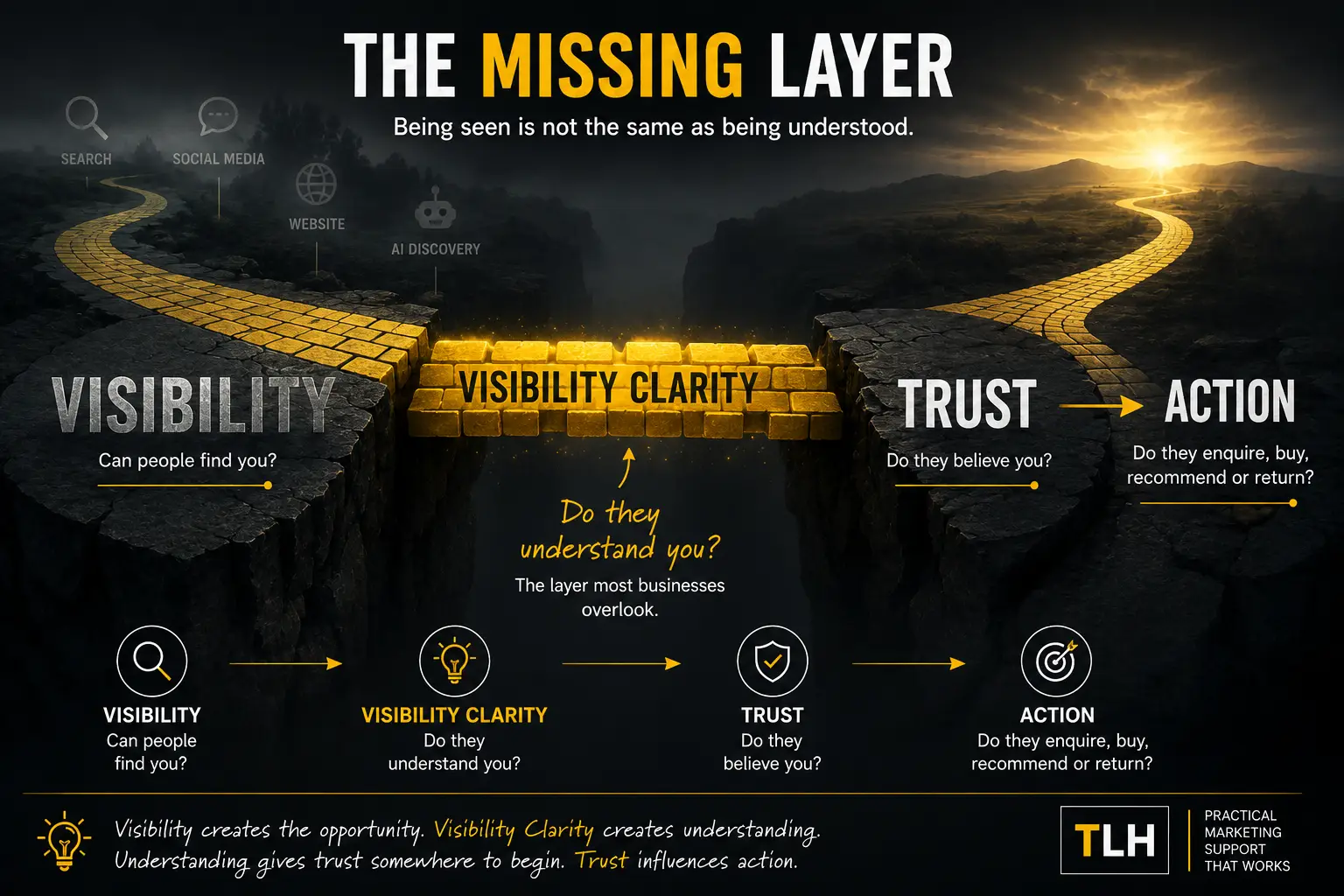
Visibility creates the opportunity to be noticed.
Visibility Clarity helps people make sense of what they have noticed.
And understanding gives trust somewhere to begin.
Trust Needs Something to Attach To
Businesses spend a great deal of time adding trust signals to their marketing.
Five-star reviews.
Accreditations.
Industry memberships.
Awards.
Case studies.
Years of experience.
And quite rightly. All of these can be valuable.
But there is a small problem.
Trust signals need context.
A website proudly tells you the company has 30 years of experience.
Thirty years doing what?
Another tells you it has more than 500 five-star reviews.
Reviews from people who needed what?
A row of six accreditation logos sits underneath the main banner.
Are any of them relevant to the service you are looking for?
The problem is not necessarily the trust signal.
The problem may be that the person has not yet understood enough about the business to give that trust signal meaning.
Now imagine the visitor already understands that a company specialises in repairing and maintaining variable speed drives used in manufacturing environments.
They then discover the business has decades of experience in industrial drive systems, holds relevant manufacturer accreditations and has case studies showing similar repair work.
The trust signals have something to attach to.
They reinforce an understanding that is already beginning to form.
Without context, trust signals can become another collection of claims.
With context, they can help build confidence.
What Visibility Clarity Looks Like
Visibility Clarity does not necessarily require more words.
Often, it requires more precise ones.
Consider this:
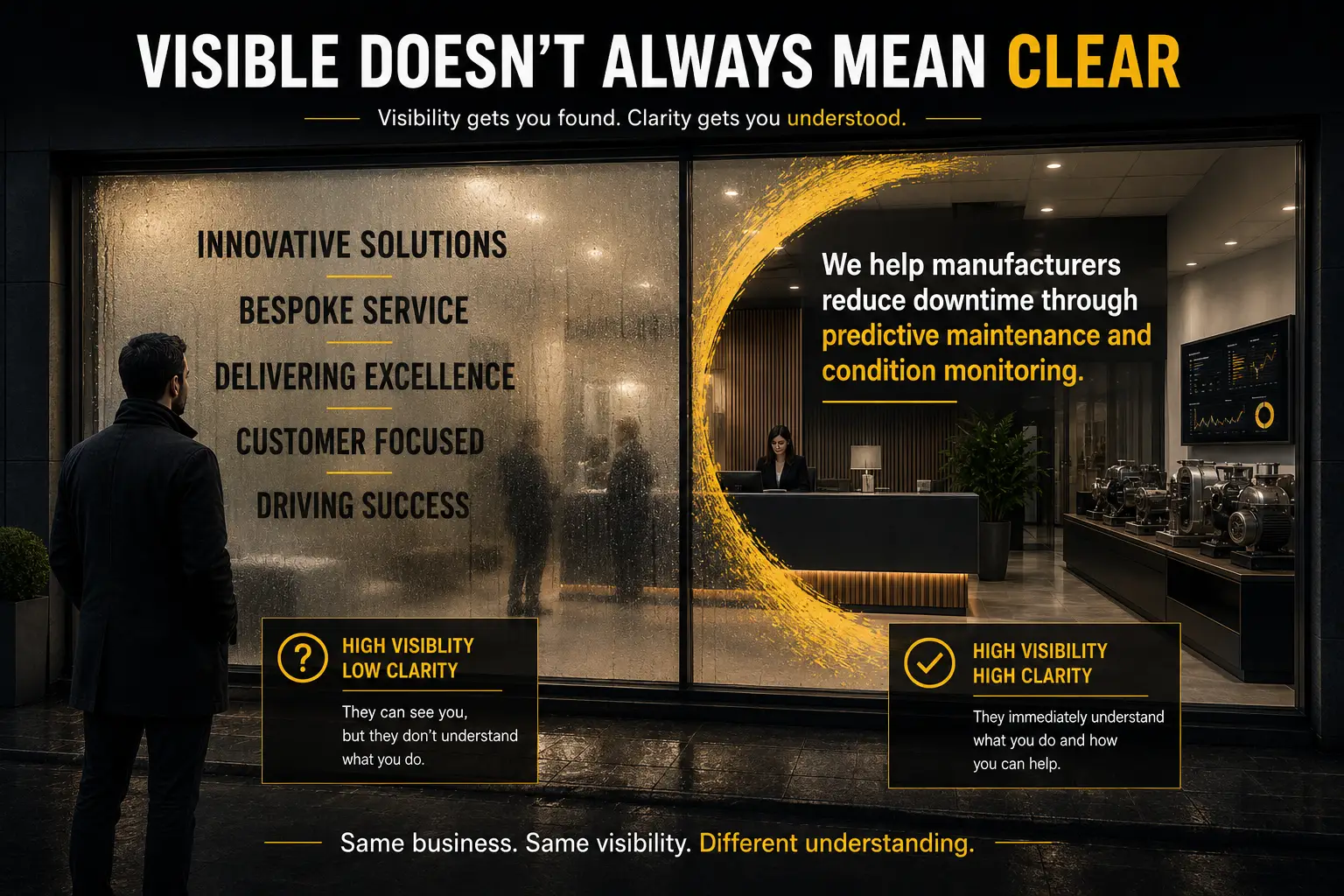
Innovative solutions for modern businesses.
It sounds positive.
It sounds professional.
It could also describe thousands of companies.
What does the business do?
Who is it for?
What kind of solution does it provide?
Now compare it with:
We help manufacturers reduce downtime through predictive maintenance and condition monitoring.
The second statement gives the person something to work with.
A manufacturer experiencing repeated machinery failures can begin assessing relevance immediately.
A retailer looking for a new EPOS system can equally quickly decide this probably isn’t the company they need.
Both outcomes are useful.
Clarity is not about persuading every person who encounters a business to become a customer.
It is about helping people understand enough to decide whether the business is relevant to them.
That is Visibility Clarity.
Where Visibility Clarity Breaks Down
Sometimes the problem is generic messaging.
Bespoke solutions.
Customer-focused service.
Innovative thinking.
Delivering excellence.
All perfectly pleasant. All suitably professional. And all capable of describing several thousand businesses.
The words may sound impressive internally, but they often give potential customers very little information to work with.
Sometimes the problem is corporate or industry language.
A business uses terminology every day and gradually forgets that its customers do not.
The internal team knows exactly what a service acronym means.
The customer does not.
Sometimes the problem is inconsistent positioning.
A company’s LinkedIn profile describes it as a consultancy.
Its website focuses heavily on training.
Its Google Business Profile suggests it provides outsourced services.
Its social media talks almost exclusively about one specialist product.
A potential customer encounters the business in several places and has to rebuild their understanding each time.
The inconsistency may even start inside the business.
Ask the Managing Director what the company does and they may talk about the problems it solves. The Operations Director may focus on how those services are delivered. The sales team may lead with the services that are easiest to sell right now, while the marketing team is working from a service list agreed two years ago.
Nobody is necessarily wrong.
But if those different versions gradually find their way into the company’s marketing, the picture seen by a potential customer can become increasingly blurred.
And sometimes there are simply too many competing messages.
The business provides 15 services to six different customer groups and tries to explain all of them in the first screen of its website.
Everything is technically included.
Very little is immediately clear.
The business may be visible in all the right places.
But every encounter requires effort to interpret.
Communication Friction: What Happens When Understanding Breaks Down?
What happens when somebody cannot quickly make sense of a business?
We cannot know the answer in every individual case.
But we can make some reasonable hypotheses.
They may go back to the search results and open another website.
They may delay making a decision.
They may ask somebody else for a recommendation.
They may assume the business does not provide the service they need.
They may decide to come back later and then forget.
They may simply keep scrolling.
Confusion does not always produce a dramatic rejection.
There is rarely an angry email saying:
“I was considering becoming a customer, but your positioning was inconsistent and I experienced excessive communication friction.”
It would certainly make marketing analysis easier if there were.
Instead, people simply disappear.
That is what makes communication friction difficult to spot.
Every unanswered question asks the potential customer to do a little more work.
Every vague statement requires interpretation.
Every inconsistency introduces doubt.
One point of confusion may not matter.
Several points of confusion across a customer journey may quietly become the reason somebody chooses a business that feels easier to understand.
Why Visibility Clarity Matters More Now
People are exposed to an enormous amount of information.
They skim websites.
Scroll through social media.
Move between search results.
Read reviews.
Ask AI tools questions.
Receive recommendations in WhatsApp groups and conversations.
And customer journeys are rarely neat and tidy.
Much as marketers might like them to be.
Someone may first encounter a business through a LinkedIn post.
Three weeks later, they see the company in a Google search.
A month after that, somebody mentions the same business in a conversation.
Eventually, they visit the website.
At each stage, they are adding information to their understanding of that business.
Or they are being asked to reinterpret it.
If the social media content suggests one thing, the search result another and the website something else entirely, the potential customer has to work harder to establish a clear picture.
If each encounter reinforces the same basic understanding, the business becomes easier to make sense of.
In a world of fragmented attention and increasingly non-linear customer journeys, businesses may have less control over where somebody first encounters them.
But they can influence how clearly they communicate when that encounter happens.
AI Is Reinforcing the Need for Clarity
AI has added another layer to how businesses are discovered.
People are increasingly asking conversational questions rather than relying entirely on short keyword searches.
AI systems may then interpret, summarise and combine information from different sources when forming an answer.
That does not mean businesses should suddenly rewrite everything for robots.
People have always needed clear information.
But AI discovery does reinforce an existing problem.
If a business describes itself vaguely on its website, differently across external profiles and inconsistently through its content, there may be more room for interpretation.
If the business communicates clearly and consistently, it may be easier for both people and systems to understand what the company does and when it is relevant.
But clarity also depends on whether the digital picture is complete. A business may communicate clearly and still have important services, expertise, relationships or evidence missing from its online presence. We explore how to identify the difference between what a business genuinely knows and does and what its digital presence demonstrates in Do Search Engines and AI Understand Your Business?
The principle is not particularly futuristic.
Clear information is easier to interpret than unclear information.
AI has simply made the importance of interpretation harder to ignore.
Visibility Clarity Is Built Across the Customer Journey
Visibility Clarity is not created by one perfect homepage headline.
It is built cumulatively.
A potential customer reads a service page and clearly understands what the business provides.
Later, they read reviews from customers describing their experience of that same service.
They see a social post showing the work in practice.
Perhaps they encounter an AI answer that mentions the business in a relevant context.
Then somebody recommends the company in conversation.
Each encounter adds another piece to the picture.
The business becomes easier to understand.
The customer’s confidence in their interpretation increases.
Now consider the opposite journey.
The service page is vague.
The reviews praise the company for being “great” but rarely mention what work was carried out.
The social media content jumps between unrelated subjects.
The business is categorised differently across directories.
A recommendation introduces a service the customer did not even realise the company offered.
The business is visible.
Potentially very visible.
But the picture never quite comes into focus.
Every touchpoint either strengthens understanding or introduces confusion.
Visibility Clarity is built across all of them.
Is Your Business Visible but Difficult to Understand?
There are some uncomfortable questions worth asking.
And they can be surprisingly difficult to answer from inside a business.
When you already know what every service, acronym and process means, it is very easy to read your own marketing with all of that knowledge already filled in.
Your potential customers don’t have that advantage.
Could somebody explain what your business does after spending 30 seconds on your website?
Are you memorable for anything specific?
Would different members of your team describe the business in broadly the same way?
Do your reviews reinforce the services and expertise you want to be known for?
Does your social media support the same understanding created by your website?
If somebody encounters your business in three different places, will each encounter add to the same picture?
Are you using terminology your customers genuinely understand?
Are you highly visible but still making people work too hard to understand why you are relevant?
And perhaps most importantly:
Are you trying to solve an understanding problem by chasing more visibility?
The Last Word
Visibility matters.
A business that cannot be found has fewer opportunities to be considered.
But discovery is not the end of the process.
It is the beginning of interpretation.
Once somebody encounters a business, they still need to make sense of what they have found.
What does this company do?
Is it relevant to me?
Does it understand the problem I have?
Do the things I am seeing give me confidence in that understanding?
Only then do trust signals have meaningful context.
This is the missing layer I call Visibility Clarity.
Visibility creates opportunity.
Visibility Clarity creates understanding.
Understanding gives trust something to attach to.
Trust influences action.
Businesses have spent years competing to be seen.
In an increasingly crowded and fragmented digital world, visibility alone may no longer be enough.
Being understood may be becoming just as important as being found.
Part of the Marketing Clarity Series
This article is part of the Marketing Clarity series from The Last Hurdle, exploring the thinking behind clearer, more effective marketing.
From visibility and customer journeys to AI discovery and communication friction, the series looks at how people find, understand and build confidence in businesses.