Because before you decide what to do,
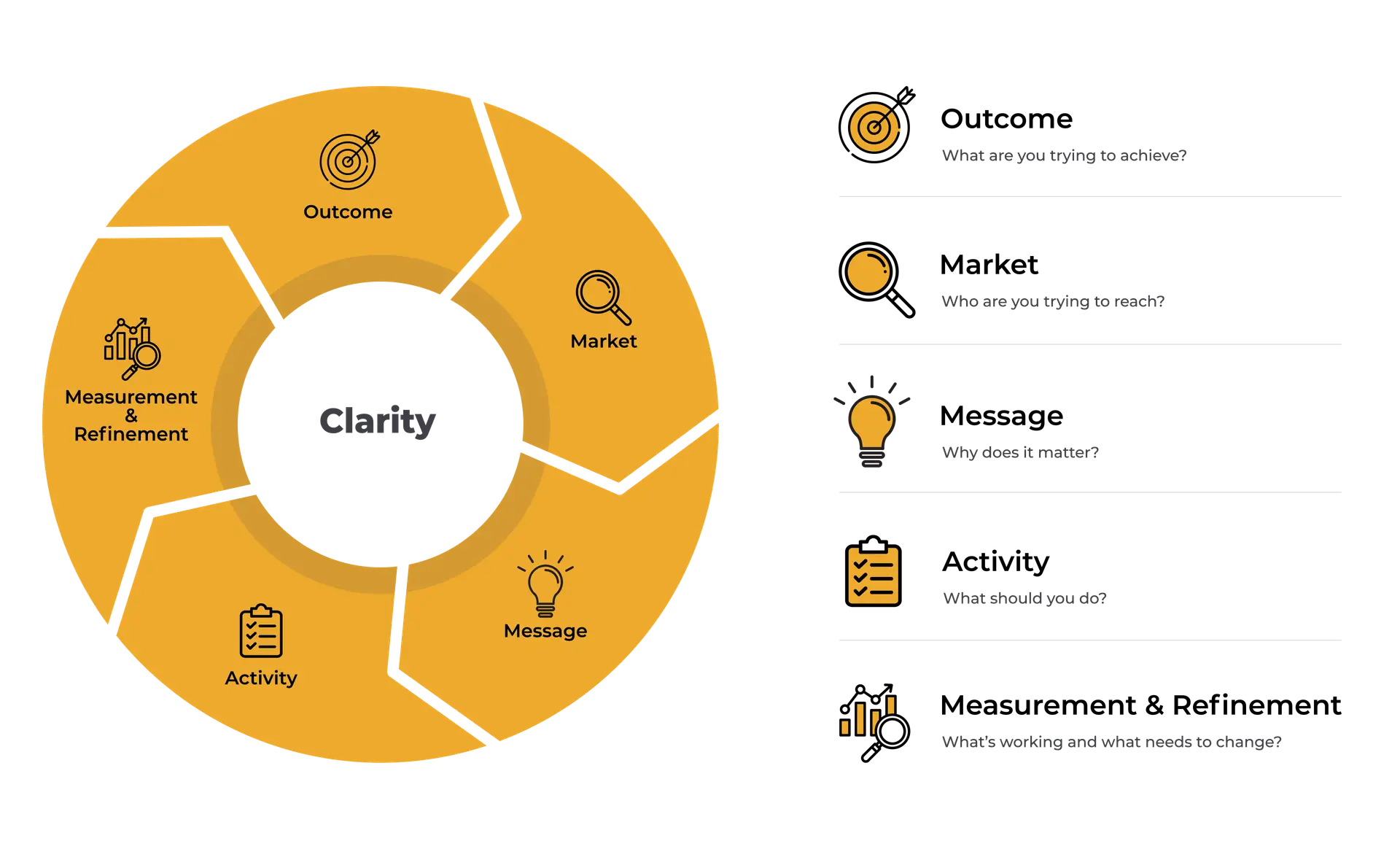
you need to understand:
what you’re marketing,
who you’re marketing to,
and ultimately, what your outcome is.
Most businesses don’t struggle with effort.
They’re doing things.
Updating their website.
Investing in SEO.
Posting on social media.
But the results don’t match the activity.
And when that happens, the instinct is to do more.
More content.
More spend.
More visibility.
But in our experience, that’s rarely the answer.
Because marketing doesn’t usually fail through lack of activity.
👉 It fails when the thinking behind it isn’t clear.
And this is where most marketing quietly starts to drift off course.
The name came from a simple observation.
Years ago, I found myself in a room full of business owners, people who were genuinely brilliant at what they did.
They delivered exceptional work.
They cared about their clients.
They went above and beyond.
But when it came to marketing themselves?
They struggled.
Some didn’t know where to start.
Some didn’t realise how good they were.
Others didn’t know how to explain what they did in a way that made sense to their customers.
They had:
But they couldn’t bridge the gap between:
👉 doing the work
and
👉 communicating the value
That gap is what we call the last hurdle.
And most businesses don’t realise they’re stuck at it.
We help businesses get over that last hurdle.
Not by adding more noise.
Not by pushing more activity.
👉 By bringing clarity to what’s already there.
Because most businesses don’t need more marketing activity.
They need help explaining what they do, to the right people, in the right way.
And that’s where our framework comes in.
We’re not the right fit for everyone, and that’s intentional.
Our approach tends to work best for businesses who:
And it’s probably not the right fit if you’re:
Most marketing starts with activity.
Ours starts with understanding.
We start with the outcome and work backwards from there.
1.
More enquiries?
Better quality leads?
More visibility in a specific market?
Stronger repeat business?
If the outcome isn’t clear, everything that follows is guesswork.
And guesswork, even when executed well, rarely produces consistent results.
2.
What do they already know?
What are their pain points?
What problem are you solving?
And just as importantly:
What are they comparing you against?
Because customers don’t assess your business in isolation.
They compare you to other options, often quickly, and often subconsciously.
3.
Who is this for?
What does your product or service actually do?
What benefit does it deliver?
Because clarity on its own is not enough.
👉 People also need reasons to believe what they’re seeing.
Without that, even a clear message won’t convert.
4.
SEO.
Website improvements.
Content.
Social media. Etc.
We don’t recommend activity because it’s popular.
We recommend it because it fits the situation.
Because when activity is built on clear thinking, it becomes far more effective and far less wasteful.
5.
Where are enquiries coming from?
What’s performing well?
Where are people dropping off?
Marketing isn’t set and forget.
👉 Measurement never stops.
👉 Refinement is continuous.
Because clarity isn’t a one-time exercise, it evolves as your business grows.
6.
👉 why someone should choose you
What makes you different?
What makes you relevant?
Where do you sit in the market?
Because marketing is not just about being visible.
👉 It’s about being the right choice.
Clients don’t come to us asking for clarity.
They come with a request.
“We need SEO.”
“We need social media.”
“We need our website to be better.”
And yes, we can help with all of those.
But before we do, we ask:
What are you trying to achieve?
Who are you trying to reach?
What does success look like?
Because without that, even the right activity can deliver the wrong result.
This isn’t theoretical. It shows up clearly when you look at real businesses.
We’ve worked with an engineering company for over a decade.
When I first met them, I’ll be honest, I didn’t fully understand what they did. Their website didn’t make it easy.
So, before the initial meeting, I sent their website to someone I knew would be relevant.
I simply asked:
👉 “Does this make sense to you?”
His reply:
“I don’t know anything about this.
What has this got to do with me?
Am I supposed to understand this?”
Underneath his name and job title:
👉 Cost Planning Manager at Carillion
Exactly the type of organisation they wanted to reach.
But the target market, involved in decision-making:
👉 didn’t understand it
👉 didn’t see the relevance
👉 didn’t recognise himself in the message
That’s not a marketing channel problem.
👉 That’s a clarity problem.
And it showed up elsewhere too.
The website was getting strong traffic. But the bounce rate was over 80%.
Why?
They had completed work on a McDonald’s site in a specific town.
A case study was added. Which meant they were ranking for:
👉 “McDonald’s [that town]”
So, people searching for:
landed on an electrical engineering website.
They weren’t looking for engineering.
👉 They just wanted a burger.
So, they left.
That traffic looked impressive. But it delivered nothing.
We would prefer:
👉 200 relevant visitors
over
👉 50,000 irrelevant ones
every single time.
Now compare that to a small, family-run blinds company.
They design and install made-to-measure blinds across Northamptonshire and Milton Keynes.
Their marketing relied heavily on social media.
And for a time, it worked.
Then things changed.
Reach dropped.
Enquiries became inconsistent.
So instead of doing more, we stepped back.
We looked at:
Once we reviewed and understood these, this is the activity we introduced.
👉 One blog per month.
Each one based on real installations:
Not polished showroom images.
👉 Real environments customers recognised.
And that’s why it worked.
Within six months:
👉 The website went from fairly inactive
to generating 2–5 enquiries per day
From one blog per month.
The budget and activity increased.
Because the results made sense.
If this feels familiar, it’s usually not an activity problem.
It’s a clarity problem.
Most long-term clients don’t start with your biggest service.
They start small.
A first job.
A trial.
A low-risk step.
So, we ask:
What brought your best clients in?
Because that should shape your marketing.
And when it does, your marketing starts to reflect how people actually behave, not how we assume they behave.
The right strategy isn’t just about the market.
It has to fit:
Because there’s no point building a strategy that can’t be sustained.
Consistency beats intensity every time.
In 15 years, we’ve seen countless shifts.
And with every shift comes noise.
“You should be doing this.”
“You’re missing out if you’re not doing that.”
But more noise doesn’t create better marketing.
👉 It creates confusion.
We don’t follow trends for the sake of it.
We focus on what makes sense.
We help you:
Because when the thinking is clear,
everything that follows starts to work.
If you’d like to explore more of how we think about this, our Marketing Clarity hub brings these ideas together in more detail.
Our approach shapes how we work.
We don’t jump straight into activity.
We ask questions.
We challenge assumptions.
We take time to understand what’s really going on.
Sometimes that means slowing things down before speeding things up.
Because fixing the right problem always leads to better results.
You don’t need to have everything figured out before getting in touch.
Most people come to us with a sense that something isn’t quite working,
but aren’t sure why.
That’s exactly where we start.
1.
We start with a straightforward conversation about your business, your current marketing, and what you’re trying to achieve.
No pitch. No pressure. Just understanding what’s really going on.
2.
We look at your marketing through the same lens we’ve outlined here:
your outcome
your market
your message
your current activity
This helps us identify where things are aligned
and where they’re not.
3.
You leave with a clearer understanding of:
what’s working
what isn’t
and what to do next
No jargon. No overcomplication. Just clarity.
There’s no obligation to move forward.
This is about understanding what’s right first.
If your marketing feels busy but isn’t delivering results,
it’s usually not an activity problem, it’s a clarity problem.
👉 Let’s fix that.
Tell us a little about your business, what you’re currently doing, and what you’re trying to achieve.
We’ll take a look and come back with a clear, practical perspective on what’s working, what isn’t, and where to focus next.
No pressure. No obligation. Just clarity.