

Your Website Is a Business Asset – Treat The Hosting Like One
As businesses grow, they naturally invest in better infrastructure.
They move into larger premises. They upgrade ageing computers. They replace old company vehicles. They invest in better software, stronger security and more efficient systems. As the business becomes more valuable, so does the infrastructure supporting it.
It’s a natural progression.
Yet there’s one business asset whose infrastructure is often overlooked.
The website.
Or, more accurately, the infrastructure supporting it.
Many businesses continue running an increasingly valuable website on the same basic hosting package they chose years earlier, when the website was little more than an online brochure. Since then they’ve invested in professional design, SEO, content, Google Ads, email marketing, AI optimisation and countless hours improving the customer experience. Their website has evolved into one of their most important business assets, but the foundations beneath it haven’t.
This isn’t an article suggesting lower-cost hosting is inherently bad. For a new business with a simple brochure website, it can be the perfect place to start.
The problem comes when businesses fail to recognise that, just like their premises, vehicles and equipment, their website infrastructure should evolve as the business grows.
Because every improvement you make to your website increases its value.
The question is…
Is the infrastructure beneath it still fit for purpose?
Your Website Is Business Infrastructure
There was a time when a business website was little more than an online brochure.
It listed your services, displayed your contact details and perhaps included a few photographs. Once it had been built, very little changed. As long as it remained online, few businesses gave much thought to what was happening behind the scenes.
Today’s websites are very different.
For many organisations, the website has become the centre of their marketing activity. It attracts visitors from search engines, AI platforms, social media, email campaigns and paid advertising. It captures enquiries, supports sales, provides information, integrates with third-party systems and often acts as the first impression a potential customer has of the business.
In other words, your website is no longer simply part of your marketing.
It has become part of your business infrastructure.
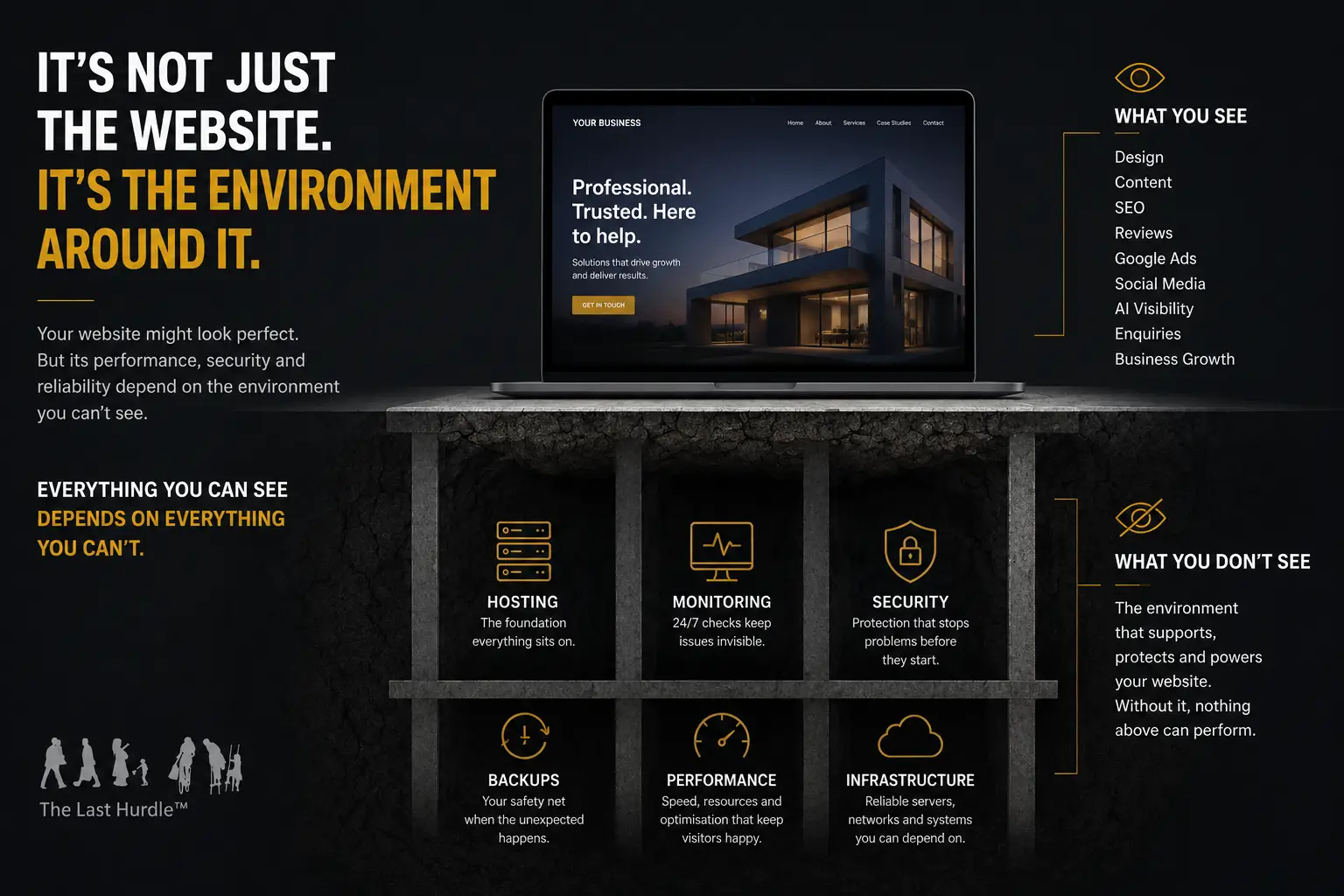
Like any important business asset, your website depends on the systems supporting it. The hosting environment, security, backups, performance optimisation, monitoring and ongoing maintenance all contribute to how reliably it performs.
When everything is working as expected, these elements remain largely invisible.
When they aren’t, the consequences can affect everything built on top of them.
Think about it this way.
You wouldn’t spend thousands improving a building while ignoring its foundations. You wouldn’t install the latest equipment into premises with unreliable electrics. Likewise, it makes little sense to continually invest in improving your website if the infrastructure supporting it hasn’t evolved alongside your business.
Your website isn’t just where people learn about your business.
For many organisations, it’s where business begins.
That makes the infrastructure beneath it just as important as the website itself.
Every Improvement You Make Adds Value
Very few business websites stand still.
Over time, they evolve alongside the business.
Perhaps you’ve invested in a professional redesign. Maybe you’ve worked on improving your search engine visibility. You may have published regular blog articles, refined your messaging, added new service pages, encouraged customer reviews or invested in Google Ads to generate more enquiries.
More recently, many businesses have also begun thinking about AI visibility, ensuring their websites provide clear, structured information that both people and AI platforms can understand.
Individually, each improvement may seem relatively small.
Collectively, they represent a significant investment in one of your most valuable business assets.
Every improvement makes your website work harder for your business.
Every new page creates another opportunity to be found.
Every article builds authority.
Every review strengthens trust.
Every optimisation improves the experience for future visitors.
Every enquiry generated increases the return on everything that came before it.
Over time, your website becomes far more than a collection of pages.
It becomes an asset that works for your business around the clock.
The value of a website isn’t measured by what it cost to build. It’s measured by how much your business depends on it.
For many businesses, it’s also become their most consistent salesperson, representing the company 24 hours a day, seven days a week.
Yet it’s surprising how often businesses continue supporting that increasingly valuable asset with the same hosting environment they selected years earlier, before much of that investment had even been made.
If you’re investing in SEO, AEO, content, paid advertising and continually improving your website, don’t overlook the one thing every one of those investments depends upon.
Your hosting isn’t where your website investment ends. It’s where all of its value begins.

The Most Expensive £20 You’ll Ever Save
Over the years, I’ve worked with businesses that are genuinely committed to growing their online presence.
They’re investing in SEO.
They’re beginning to invest in AEO.
They’re producing high-quality content.
They’re running Google Ads.
They’re improving their websites.
They’re refining their customer journeys.
They’re doing all the right things to attract more visitors and generate more enquiries.
Then we start talking about hosting.
Suddenly, the conversation changes.
“Can we save £20 a month?”
It’s always fascinated me how quickly the conversation changes.
It’s one of the biggest contradictions I see.
Businesses are prepared to invest significant amounts attracting people to their website, yet hesitate over investing a little more in the infrastructure that those visitors actually arrive on.
Let’s put that into perspective.
That extra £20 per month represents around £240 a year.
Less than many businesses spend taking a client out for lunch.
Less than a single day of Google Ads.
Less than a couple of hours of professional consultancy.
Yet it’s protecting an asset you’ve spent years building.
I’m not suggesting every business needs premium hosting from day one.
A new business with a four-page brochure website probably doesn’t.
But businesses evolve.
Your website evolves.
The business becomes more dependent on it.
Its value increases.
At some point, your website stops being a simple online brochure and becomes one of your most important business assets.
That’s the point where continuing to make decisions based solely on the monthly hosting fee stops making business sense.
Saving £20 a month might feel like sensible budgeting.
But if that decision affects the reliability, performance or resilience of a website you’ve invested thousands of pounds into, it may become the most expensive £20 you’ll ever save.
Because your marketing doesn’t begin when someone finds your website.
It begins the moment they try to access it.
Every pound you spend on marketing assumes one thing.
That your website will be there when people arrive.
How Certain Are You?
One of the things I’ve noticed over the years is that website hosting is still too often treated as an IT purchase rather than a business decision.
That’s understandable.
Hosting is usually arranged by whoever built the website or the company’s IT provider.
Neither approach is necessarily wrong.
But they’re often looking at the website through different lenses.
An IT provider quite rightly focuses on keeping systems operational.
A marketing agency focuses on helping businesses generate enquiries and improve visibility.
Managed hosting bridges those two worlds.
It isn’t just about keeping a server online.
It’s about protecting one of your most valuable business assets.
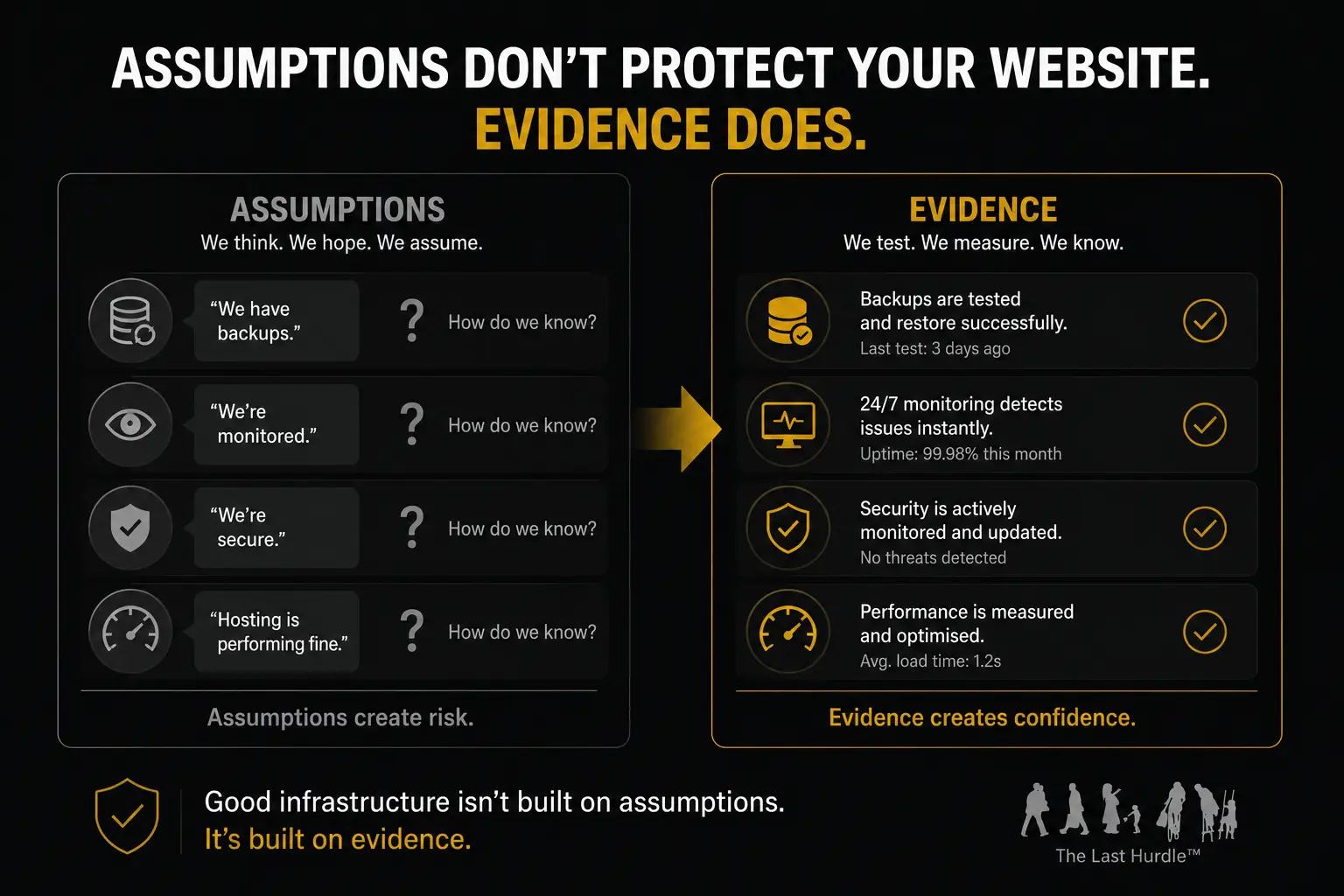
That’s an important distinction because many businesses believe they already have everything covered.
“We have backups.”
Do you?
Or do you simply have software that’s attempting to create backups?
When was the last time someone checked they were running successfully?
When was the last time a backup was restored to verify it was actually usable?
Because the worst possible time to discover a backup is corrupt or incomplete is during a live incident.
The same applies elsewhere.
“We’re monitored.”
Are you?
What exactly is being monitored?
Website availability?
Performance?
SSL certificates?
Server resources?
Security events?
Or is someone simply waiting for a customer to report a problem?
“We’re secure.”
Compared with what?
How often are updates reviewed?
Who checks for unusual activity?
Who’s monitoring failed login attempts?
Who’s reviewing firewall events?
Who’s looking for patterns before they become incidents?
These aren’t technical questions.
They’re business questions.
Because technology should support the business, not the other way around.
They also aren’t questions most businesses think to ask.
We naturally assume that if a website is online, backups exist, security is in place and monitoring is happening behind the scenes.
In reality, those assumptions are often based on trust rather than verification.
That’s perfectly understandable.
Most business owners aren’t website infrastructure specialists, just as I wouldn’t expect to understand the finer details of commercial accounting or employment law.
But that’s exactly why these questions matter.
You don’t need to know how to configure a backup system.
You simply need the confidence to ask:
“How do we know?”
If the answer is “because we’ve never had a problem”, remember what we discussed earlier… absence of evidence isn’t evidence of absence.
Because every one of them relates to protecting the value of an asset your business depends upon.
Good infrastructure isn’t built on assumptions.
It’s built on verification.
The businesses that recover quickest from incidents aren’t always the ones with the most expensive systems.
They’re often the ones that already know what’s happening because they measure it, test it and review it regularly.
Growing Businesses Outgrow Their Infrastructure
Think back to when your business first started.
Like many businesses, you probably made sensible decisions based on where you were at the time.
You may have worked from home before moving into an office.
You may have started with one laptop before investing in better equipment.
Perhaps you used your own car before purchasing a company vehicle.
Every investment reflected the needs of the business at that point in its journey.
Your website is no different.
A basic shared hosting environment can be the perfect solution for a new business with a simple brochure website and relatively few visitors. There’s absolutely nothing wrong with that.
The mistake isn’t choosing lower-cost hosting.
The mistake is never reviewing that decision as your business grows.
Over the years, your website changes.
You add new services.
You publish articles.
You improve your search visibility.
You attract more visitors.
You introduce new functionality.
You connect third-party systems.
You rely on it to generate enquiries.
Gradually, your website becomes one of the hardest-working assets in your business.
Yet many organisations continue supporting that increasingly valuable asset with exactly the same infrastructure they chose years earlier.
If you looked at every other part of your business, would that make sense?
Would you still expect your team to work from computers purchased a decade ago?
Would you continue operating from premises that no longer met your needs?
Would you ask your sales team to visit important clients in vehicles that no longer reflected the quality of your business?
Probably not.
Business growth naturally leads to better infrastructure.
Your website should be no exception.
As your business evolves, the infrastructure supporting your website should evolve with it.
Not because the original decision was wrong.
But because your business has outgrown it.
It’s Like Buying Property
One way I often explain website hosting is to compare it to buying a house.
Imagine you’ve found your dream home.
The house itself is beautiful.
It’s exactly what you wanted.
But buying a property isn’t just about the house.
You’re also buying the environment surrounding it.
A well-managed neighbourhood gives you confidence. The roads are maintained. The street lighting works. The utilities are reliable. The area is looked after. If something unusual happens, there’s a neighbourhood watch keeping an eye on things and raising the alarm when necessary.
Just as importantly, the people around you generally take pride in where they live. They respect boundaries, look after their own properties and contribute to a neighbourhood that protects the value of everyone’s investment.
Now imagine a different environment.
The house itself still looks good.
In fact, when you first viewed it, nothing immediately seemed wrong.
But after moving in, you start to notice things.
The roads are full of potholes.
Street lights aren’t repaired.
The area isn’t particularly well maintained.
Some neighbouring properties are neglected.
Others attract the sort of activity you’d rather not live next to.
None of those things change the structure of your own house.
But they do affect your experience of living there.
More importantly, they can quietly affect the value of your property.
Website hosting isn’t just somewhere your website lives. It’s the environment it lives in.
Your website doesn’t exist in isolation. Depending on the type of hosting you’ve chosen, it’s often sharing an environment with many other websites. You don’t necessarily know who those neighbours are, how well they’re maintained or what impact their behaviour may have on the wider environment.
Most of the time you’ll never notice.
And that’s exactly the point.
Many of these things are invisible to the business owner.
You don’t see the performance issues developing.
You don’t see poor resource management.
You don’t see security events.
You don’t see abusive traffic.
You don’t see neighbouring websites damaging the reputation of the wider environment.
You simply assume everything is working as it should.
Until one day it isn’t.
Choosing website hosting isn’t simply choosing somewhere for your website to live.
It’s choosing the environment your business is investing in.
Absence of Evidence Isn’t Evidence of Absence
A recent website investigation reminded me of a phrase that’s often used in science, engineering and business:
Absence of evidence isn’t evidence of absence.
In simple terms, just because you haven’t seen a problem doesn’t mean one doesn’t exist.
During the investigation, the website wasn’t permanently offline.
It wasn’t obviously broken.
Most of the time it worked exactly as expected.
The problem was that it became intermittently unavailable for short periods throughout the day.
Long enough for visitors to experience problems.
Short enough that, if you checked the website a few minutes later, everything appeared perfectly normal.
It left me with one question.
How many businesses confidently say:
“We’ve never had a hosting problem.”
What they often mean is:
“We’ve never detected a hosting problem.”
Those are two very different statements.
Without monitoring, there’s often no evidence to suggest anything is wrong. Customers rarely email to tell you your website timed out. Prospective clients don’t usually ring to say they gave up after waiting for a page to load. Search engines don’t notify you that they encountered intermittent issues while crawling your site. AI platforms don’t explain that they couldn’t reliably access your content.
They simply move on.
That’s what makes website availability so difficult to judge.
Unlike many other business systems, websites don’t always fail dramatically.
Sometimes they fail quietly.
A form takes too long to submit.
A page doesn’t load.
A timeout occurs.
A visitor leaves.
Five minutes later everything appears perfectly normal again.
If you only ever check your own website manually, there’s every chance you’ll never witness those moments.
That doesn’t mean they never happened.
It simply means you weren’t looking when they did.
That’s why website monitoring is so important.
Not because you expect your website to fail.
But because it replaces assumptions with evidence.
It tells you what’s happening, when it’s happening and how often it’s happening.
Instead of saying:
“I think everything is working.”
You can confidently say:
“I know it is.”
Invisible Problems Cost Real Business
One of the biggest challenges with website performance is that the true cost is rarely visible.
When a visitor arrives at your website and everything works as expected, the journey continues.
When it doesn’t, the journey often ends without you ever knowing it began.
Imagine you’ve spent months improving your search engine visibility.
You’ve invested in SEO.
You’ve created useful content.
You’ve earned positive reviews.
You’ve refined your messaging.
Perhaps you’re also investing in Google Ads or optimising your website so AI platforms can better understand your business.
A potential customer clicks through to your website.
Unfortunately, they happen to arrive during one of those brief periods where your website is slow to respond, a page fails to load or an enquiry form doesn’t complete.
What happens next?
Most people won’t refresh the page five or six times.
They won’t email to tell you.
They won’t ring your office to explain there was a problem.
They’ll simply leave.
Very often, they’ll visit the next business in the search results instead.
Visitors rarely separate the quality of a website from the quality of the business behind it.
If a page is slow to load, they don’t think:
“Their hosting provider must be having a problem.”
They think:
“This company doesn’t seem very professional.”
Website performance doesn’t just influence user experience.
It influences trust.
And trust is often lost long before a conversation ever begins.
The same applies to search engines and AI platforms.
They don’t make allowances because your website was only unavailable for a few minutes.
They simply record what they experienced at that moment in time.
The difficult part is that you’ll probably never know those interactions happened.
There’ll be no notification.
No warning.
No obvious sign that anything was wrong.
From your perspective, it was just another Tuesday.
This is why website monitoring is about far more than uptime statistics.
It’s about understanding what your visitors experience when you’re not looking.
Because every enquiry you never receive…
Every visitor who quietly leaves…
Every opportunity that disappears without explanation…
Has a cost.
The problem is that invisible costs rarely appear on a profit and loss statement.
That doesn’t make them any less real.
Businesses often analyse the enquiries they receive.
Few ever stop to consider the enquiries they never had the opportunity to receive.
Because unlike marketing spend, invisible losses are almost impossible to measure.

It’s No Longer Just Customers Visiting Your Website
For many years, we thought about websites in fairly simple terms.
People searched.
People clicked.
People visited.
People made enquiries.
There was a time when websites were designed almost exclusively for people.
Today’s websites have a much wider audience than many businesses realise.
Search engines regularly crawl your website to understand your content.
Today’s websites aren’t just read by people. They’re interpreted by search engines, AI platforms and countless automated systems that help determine how visible your business becomes online. AI platforms access websites to better understand businesses and answer users’ questions.
SEO tools analyse your pages.
Performance tools assess your website.
Accessibility tools review the experience you provide.
Forms communicate with CRMs.
Booking systems exchange information.
Payment gateways process transactions.
Behind the scenes, there are countless interactions taking place every day that most business owners never see.
Every one of those interactions relies on your website being available, responsive and functioning as expected.
If a customer arrives during a brief outage, they may simply visit a competitor instead.
If a search engine encounters repeated issues accessing your content, it may affect how efficiently your website is crawled.
If an AI platform struggles to retrieve information consistently, it can only work with the information it was able to access.
None of these systems send an email explaining what happened.
They simply continue with the information available to them.
That’s why businesses need to think differently about their websites.
It’s no longer just about creating a website that looks professional.
It’s about creating an environment that’s consistently available for every visitor, whether that visitor is a potential customer, a search engine or an AI platform trying to understand your business.
The modern website doesn’t simply support your marketing.
It supports your digital presence as a whole.
And every part of that digital presence depends on the infrastructure beneath it.
Monitoring Replaces Guesswork With Evidence
One of the biggest misconceptions about website monitoring is that it’s there to tell you when your website has gone offline.
In reality, that’s only a small part of the picture.
Good monitoring provides evidence.
It tells you whether your website is consistently available.
It helps identify trends before they become bigger problems.
It highlights changes in performance.
It provides an accurate history of what’s happened rather than relying on assumptions or memory.
Most importantly, it allows decisions to be based on facts.
Instead of saying:
“I think the website has been slow recently.”
You can see exactly when response times changed.
Instead of saying:
“We’ve never had any hosting problems.”
You can review the evidence.
Instead of relying on a customer to tell you something isn’t working…
…you already know.
Monitoring also changes the conversations you have when problems do occur.
Rather than contacting your hosting provider with a vague statement such as:
“The website doesn’t seem quite right.”
You can provide meaningful information.
When did the issue begin?
How long did it last?
How often has it happened?
Has performance gradually declined over time?
Is it affecting every visitor or only some?
Evidence turns opinions into productive conversations.
But perhaps the greatest benefit of monitoring is peace of mind.
If your website is one of your most valuable business assets, why wouldn’t you want to know how it’s performing?
Businesses routinely monitor sales, cash flow, stock levels, productivity and marketing performance.
Monitoring your website should be viewed no differently.
Because the objective isn’t simply to discover when something goes wrong.
It’s to have confidence that everything is working as it should.
And when it isn’t…
You’ll know.
Why We Take a Different Approach to Hosting
One question we’re occasionally asked is whether we provide website hosting as a standalone service.
In most cases, the answer is no.
That isn’t because we don’t like hosting websites.
It’s because we don’t believe hosting is simply about renting server space.
We believe it’s about taking responsibility for one of the most valuable assets a business owns. And responsibility only works when you genuinely understand what you’re responsible for.
That’s why our managed hosting service is only available for websites we build or actively manage.
By looking after both the website and the infrastructure supporting it, we understand how everything fits together.
We know the website.
We know the WordPress installation.
We know the plugins.
We know the theme.
We know the integrations.
We know how it’s expected to perform.
That means we can monitor it properly, maintain it proactively, identify potential issues earlier and make informed decisions when changes are needed.
More importantly, it means we’re not trying to support an unknown environment that we’ve had no involvement in building or maintaining.
Could we simply sell server space?
Of course.
Many companies do.
But that’s never been our philosophy.
Our role isn’t just to provide somewhere for your website to live.
Our role is to help protect one of your business’s most valuable assets and the investment you’ve made in building it.
For us, managed hosting isn’t another service we happen to offer.
It’s an extension of everything else we do.
Helping businesses build better websites.
Helping them become more visible online.
Helping them create better customer experiences.
And making sure the infrastructure beneath it all is strong enough to support that investment for years to come.
If you’re interested in understanding more about how we approach managed WordPress hosting and the infrastructure behind the websites we support, you can find more information here.
The Last Word
Businesses naturally invest in better infrastructure as they grow.
They move into larger premises.
They upgrade equipment.
They improve systems.
They strengthen security.
They invest in the tools that support their success.
Yet the infrastructure supporting one of their most valuable business assets is often left exactly where it started.
Your website has probably evolved significantly since the day it was first launched.
Every improvement you’ve made has increased its value.
Every article you’ve published.
Every customer review you’ve earned.
Every SEO improvement.
Every AI optimisation.
Every advertising campaign.
Every visitor.
Every enquiry.
They all depend on one thing.
That your website is available when people – and increasingly the systems discovering and understanding your business – arrive.
Protecting that investment starts with the infrastructure beneath it.
Because when it comes to your website…
Absence of evidence isn’t evidence of absence.
Your website has grown alongside your business.
Perhaps it’s time you started treating its infrastructure like the business asset it has become.
Part of the Marketing Clarity Series
This article is part of the Marketing Clarity series from The Last Hurdle, exploring the principles behind marketing that works.
Because creating a great website is only the beginning. Protecting the infrastructure beneath it is what allows every improvement, every visitor and every marketing investment to deliver its full value.