
Why You Need to Dust Off Your Directory Listings
For years, directory listings have been treated as an afterthought.
Many businesses claimed their profile on a handful of directories years ago, forgot about them and moved on (ours included, because there are always more pressing things to do). Others dismissed them entirely, believing they had little value beyond the occasional backlink.
That thinking made sense when our only goal was to rank in Google.
Now, the landscape is changing.
It’s changing faster than many businesses realise.
Artificial intelligence is rapidly becoming another way that customers discover local businesses, and that means directory listings deserve a second look.
It’s No Longer Just About Google
Traditionally, a customer’s journey looked something like this:
Search Google → Visit websites → Compare businesses → Make contact
Increasingly, AI is changing that process.
A customer might simply ask:
“Can you recommend a reliable boiler servicing company near Milton Keynes?”
Instead of returning a list of blue links, AI can provide a shortlist of trusted businesses, explain why they were selected and, in some cases, even help the customer request a quote without ever visiting a search engine.
That’s a fundamental shift.
For local service businesses, being recommended by AI could become just as valuable as appearing on the first page of Google.
AI Needs Confidence
Unlike traditional search engines, AI doesn’t simply match keywords.
It looks for confidence and consistency.
Can it verify who your business is?
Does your information match across trusted sources?
Are your reviews genuine and recent?
Does it understand the services you provide?
Can it confidently recommend your business over another?
Every trusted source that confirms your business information helps answer those questions. When multiple trusted sources all agree about who you are, what you do and where you are based, AI can have greater confidence in recommending your business.
Why Directory Listings Matter Again
Quality directory listings provide several important signals:
- Consistent business name, address and contact information.
- Accurate descriptions of your products and services.
- Links back to your website.
- Reviews and ratings where available.
- Additional trust signals that help verify your business online.
These have always supported SEO.
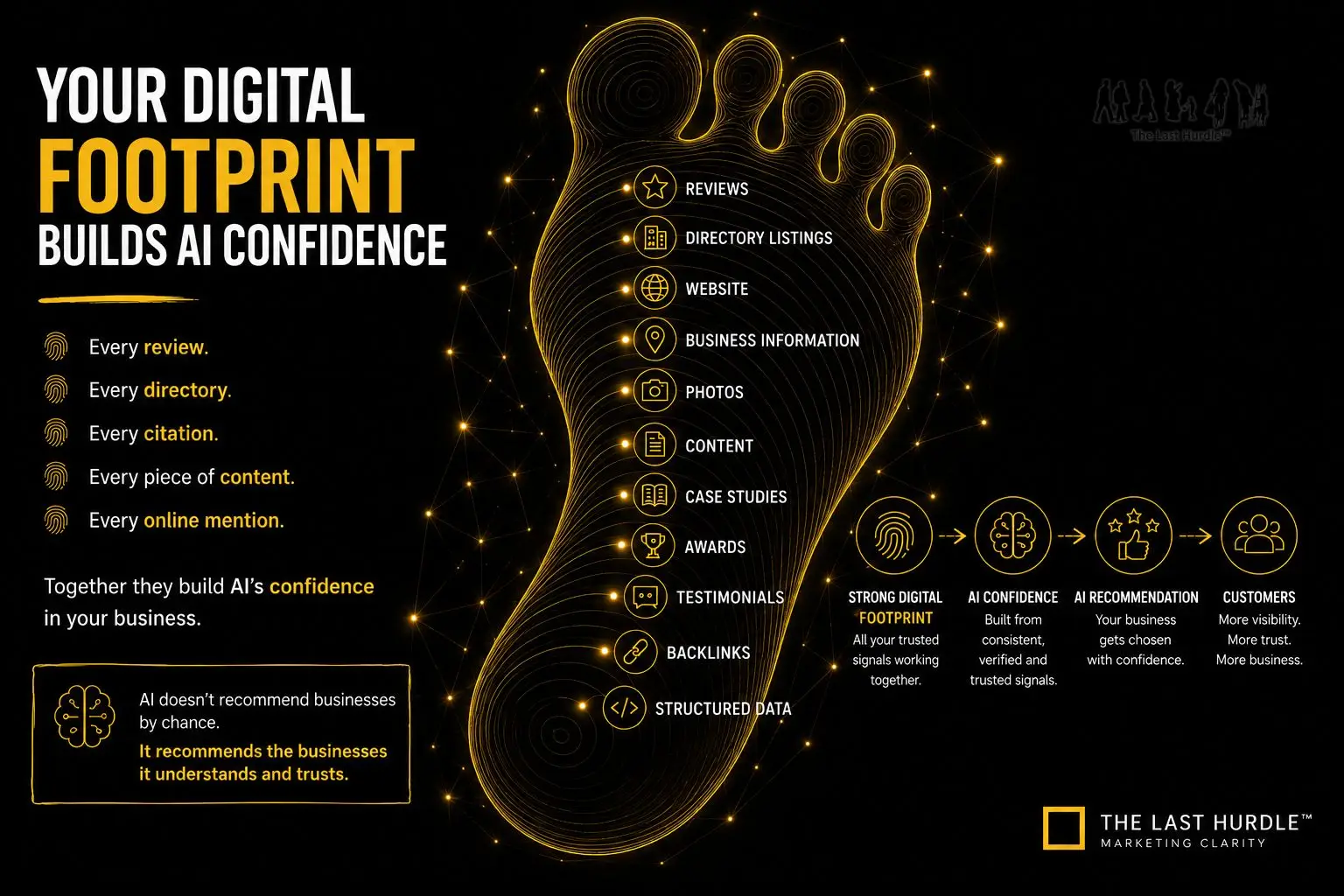
Increasingly, they also help create the consistent digital footprint that AI systems use when determining which businesses they can trust.
This isn’t a completely new discipline. Much of what supports strong SEO, including accurate business information, authoritative backlinks, genuine reviews and useful content, also helps build confidence for AI. The foundations remain the same; we’re simply applying them to a new generation of search.
Think of it this way: your website isn’t your digital footprint. It’s just the big toe. AI looks at everything connected to your business online, including directory listings, reviews, photos, content and business information. It is the complete footprint that helps build trust.
The Recent Shift
A good example of where things are heading is OpenAI’s recent agreement with Yelp.
ChatGPT can now use licensed Yelp reviews, ratings, photos and business information when making local recommendations. It is also beginning to introduce ways for users to request quotes from businesses directly through the conversation.
While Yelp itself isn’t a major player in the UK, the direction of travel is significant.
This isn’t really about Yelp.
It’s about AI moving from simply answering questions to helping people choose suppliers and start conversations with businesses.
Will every AI platform work this way? We don’t know yet. However, the direction of travel is clear: AI is becoming increasingly capable of recommending businesses, not just finding them.
Think Long Term
No one knows exactly which directories AI platforms will use in the future.
It may be review platforms.
It may be industry-specific directories.
It may be professional associations, local business listings or trusted data providers.
What we do know is this:
Businesses with consistent, accurate information across the web are in a far stronger position than businesses with outdated profiles, conflicting contact details or missing information.
A Quick Directory Health Check
If you haven’t reviewed your directory listings for a while, ask yourself:
- Is my business description still accurate?
- Are my opening hours correct?
- Have my services changed?
- Is my phone number up to date?
- Does my website link still work?
- Are there opportunities to add new photos?
- Am I actively collecting reviews?
These small updates can strengthen both your online presence and the confidence that AI platforms have in recommending your business.
You don’t need to panic or spend weeks creating hundreds of new directory listings overnight. Start by auditing the ones you already have. Update your business information, refresh your descriptions, add some new photos and encourage genuine customer reviews. They may seem like small jobs individually, but together they create a stronger digital footprint for both search engines and AI assistants.
The Last Word
Directory listings haven’t become important again because we’ve gone backwards.
They’ve become important because the internet is moving forwards.
Search is evolving into recommendations.
Recommendations are evolving into transactions.
Businesses that build a strong, consistent and trustworthy digital footprint today will be far better positioned as AI becomes an increasingly common way for customers to find local suppliers.
If your directory listings have been gathering dust for the last few years, now is an excellent time to dust them off.
The question isn’t whether directory listings are fashionable again. It’s whether your business is ready for a world where AI recommends who customers contact next.