
Social Media Has Nowhere Left to Hide
For years, businesses have been told they need to be on social media.
Facebook, Instagram, LinkedIn, X and whichever platform happened to be gaining attention at the time. Set up an account, build an audience, post regularly and stay visible.
What businesses have not always done is stop and ask whether each platform is still delivering anything worthwhile.
Accounts continue because they already exist. Because competitors are there. Because followers have been accumulated over the years. Because abandoning a platform feels like throwing away something the business has spent years building.
None of those are good enough reasons to continue investing time and money.
The question is no longer whether businesses should use social media.
It is whether each individual platform still delivers enough value to justify its place in the marketing strategy.
Increasingly, the platforms have nowhere to hide if they don’t.
The exchange of value has changed
There is nothing wrong with social media platforms making money.
They are commercial businesses. They need to remain profitable, invest in technology and pay for the enormous infrastructure required to keep their platforms running.
Businesses have also benefited enormously from using them.
For years, the exchange was relatively straightforward.
Businesses created content, encouraged their customers and employees onto the platforms, contributed to the conversations happening there and helped make those networks worth visiting.
In return, they received access to audiences, opportunities to build relationships and a degree of organic visibility.
That exchange has changed.
Organic reach has reduced. Businesses are increasingly encouraged to pay to reach audiences they have already spent years building. Features that were once simply part of using a platform are increasingly being restricted or moved behind subscriptions.
At the same time, the results many businesses receive from social media are becoming harder to justify.
The problem is not that the platforms want businesses to pay.
The problem begins when businesses are asked to pay more for something that is already delivering less.
The last two days have given us two very different examples.
Yesterday: a client decided to leave X
I have a slightly longer history with this one.
When Twitter became X and the platform increasingly moved towards paid features, The Last Hurdle paid.
Why?
Because we had built an audience of around 19,000 followers.
That’s hardly influencer territory, but it represented years of activity and, much more importantly, a genuine business network.
There were people behind those numbers.
Business owners and contacts we had met through Twitter. People whose content we regularly read, liked and retweeted. People we subsequently met in real life. Some became clients, suppliers, collaborators or simply business friends.
That was the value of Twitter for us.
It wasn’t really the follower count.
It was the network behind it.
Today, I have to hunt for many of those people.
They no longer reliably appear in our feed. Instead, we are regularly shown accounts from around the world that we have never interacted with and content with no obvious connection to our business, our previous engagement or the type of content we normally choose to consume.
And then there is the spam and other content we would never consider relevant or appropriate to the professional business environment we are trying to maintain.
At first, I wondered whether I was simply noticing the things that annoyed me.
So I tested it.
For two weeks, I deliberately searched for some of the accounts I knew we had historically interacted with.
I visited their profiles. I read their posts. I liked them. I commented. I reposted their content.
Then I watched the feed.
They still didn’t reliably appear.
Yet accounts we had never interacted with, from businesses and individuals with no obvious relevance to us, continued to be served.
I’m not suggesting a social media algorithm should only show us people we already know.
Discovery matters.
Finding new businesses, ideas and conversations was part of what made Twitter useful in the first place.
But discovery and irrelevance are not the same thing.
If I repeatedly tell a platform what I value through the accounts I search for, the content I read and the posts I actively engage with, yet those accounts remain largely absent while unrelated content continues to be served, I have to question how useful that feed has become to us as a business.
And when you are managing social media commercially, that isn’t merely irritating.
It has a cost.
We now spend more time deliberately searching for established contacts, visiting profiles and manually maintaining interactions that once happened much more naturally.
Return isn’t just about what a platform delivers.
You also have to consider how much time and money it now takes to get that result.
We have seen similar changes across the X accounts we manage for clients. Engagement has declined and maintaining useful business relationships increasingly requires more manual effort.
None of that alone means a business should leave X.
Irritation is not a marketing strategy.
And that’s precisely why one of our clients stayed.
Despite the declining engagement and the additional management time, X was still doing one commercially useful thing for them:
It was sending people to their website.
Then we reviewed last month’s reporting.
Website clicks from X: zero.
At that point, the final measurable justification for that client disappeared.
They had already experienced declining engagement. We were already investing more time to maintain relationships manually. Now the website traffic had disappeared too.
The client decided to stop investing in the platform.
That wasn’t an emotional reaction to X.
It wasn’t because we don’t particularly like what has happened to the feed.
And they haven’t left because somebody announced that X is dead.
They’ve left because the measurable reason they were using to justify the activity had reached zero.
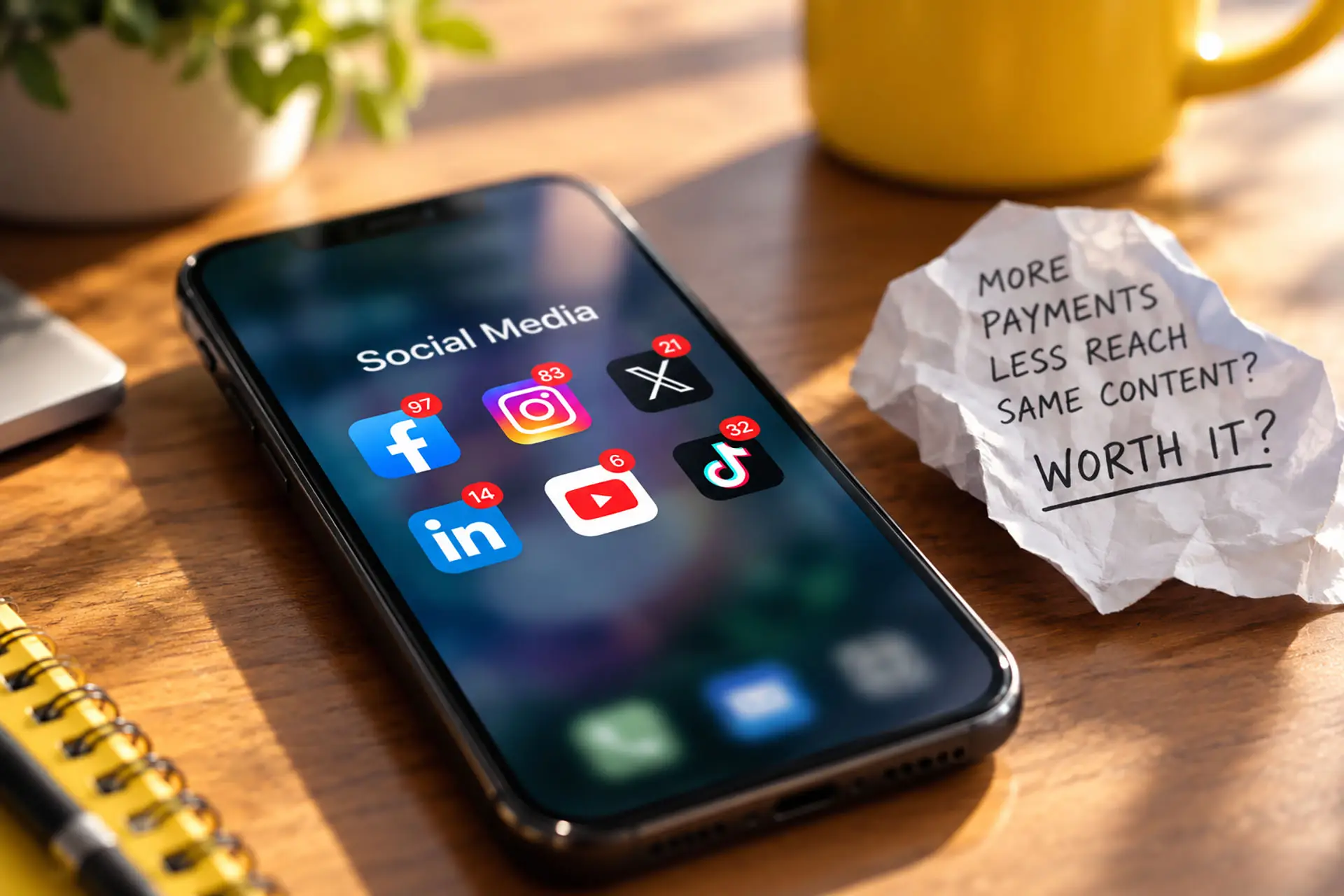
Today: Facebook asked us to pay for links
The following morning, while publishing content for another client, Facebook presented us with this message:
“You used 2 of your posts with links this month.”
We were then presented with Meta One Advanced at £33.99 per month, with “Links in posts” listed among the benefits.
So now this Business Page has been allocated two posts with links per month, or cough up £33.99 per month.
On a Business Page.
A Business Page whose organic visibility has already reduced so significantly that its continued value to this client has been questioned more than once.
And now we’re being asked to pay more to continue using a platform that is already delivering less.
That is the problem.
It isn’t the £33.99.
It isn’t that Meta wants to make money.
It’s the direction of the exchange.
The organic value has diminished. The website traffic has dwindled. Reaching followers through the feed has become increasingly difficult. And now another piece of the functionality that helped justify maintaining the Page is being restricted unless the business pays.
You don’t get to steadily reduce the value of the proposition and then assume businesses will happily pay more to preserve what’s left.
Our immediate response?
We removed the link.
Meta did not receive £33.99 from that interaction.
Facebook received one fewer outbound link.
And that reaction makes much more sense when you look at the history of this particular Business Page.
Facebook was already having to justify its place
This client has questioned before whether there is still any point in maintaining a presence on Facebook.
Each time that question has come up, we have gone back to the evidence.
We checked the website traffic through Google Analytics and Facebook was still sending enough visitors to give us a commercial reason to continue.
Not enormous amounts.
And certainly nowhere near what we had historically seen.
But enough.
So Facebook stayed in the marketing mix.
Over the years, however, that traffic has dwindled significantly.
At the same time, we had become increasingly conscious of how rarely Business Page content seemed to appear naturally in personal Facebook feeds.
But “Facebook doesn’t show Business Pages anymore” is an easy thing to say.
We wanted to know what actually happened when somebody actively demonstrated to Facebook that they were interested in a particular Page.
So we tested it.
For four weeks, from a personal Facebook profile that already followed and liked this Business Page, we deliberately sought out the Page every single day.
We visited it.
We read its content.
We liked and engaged with its posts.
Every day for 28 days.
The question was simple:
If somebody follows a Business Page, likes it, deliberately visits it every day and consistently engages with its content, will Facebook start showing that Page naturally in their personal feed?
We then watched what happened during normal, reasonably lengthy scrolls through the Facebook feed.
Over those four weeks, how many times do you think content from that Business Page appeared?
Four.
Four appearances in 28 days.
Despite following the Page.
Despite liking the Page.
Despite deliberately visiting it every day.
Despite consistently engaging with its content.
On average, after all of that deliberate activity, Facebook showed us content from a Business Page we had repeatedly demonstrated an interest in seeing once a week.
Now, that doesn’t tell us how Facebook’s algorithm works.
One test on one account couldn’t possibly do that, and I’m not going to pretend otherwise.
But it does tell us something useful about the experience of trying to maintain an organic connection between a Business Page and somebody who actively wants to see its content.
Even when we repeatedly demonstrated an interest in that Page, its content still only appeared very occasionally in the feed.
And that matters when you consider what businesses have spent years being encouraged to do.
Build your followers.
Get people to like your Page.
Create engaging content.
Encourage interaction.
Build a community.
But if somebody can follow your Page, like it, actively seek it out and repeatedly engage with its content and still rarely see you naturally in their feed, what exactly does that follower number represent?
For this client, Facebook’s saving grace had been website traffic.
Organic visibility had deteriorated, but Facebook was still getting people from the platform to an asset the business actually controlled.
That was measurable.
That had value.
And that was enough to keep Facebook in the marketing mix.
But that traffic has seriously dwindled too.
And now Facebook is potentially restricting the number of posts from this Page that can contain the very links that send people to that website.
Unless, of course, the business pays another £33.99 per month.
Or £407.88 per year.
So the question isn’t:
Is £33.99 expensive?
That’s almost irrelevant.
The question is:
Why would this business pay another £407.88 a year for a platform whose existing organic value it was already questioning?
How many businesses will pay, and how many will finally question why they are there?
That is the part I find most interesting.
Some businesses will pay.
And for some, Facebook will still deliver enough value to make £33.99 a perfectly reasonable additional marketing cost.
Others will use Facebook for purposes where outbound links aren’t particularly important. An active community, customer support, groups, events or other activity may provide perfectly good reasons to stay.
But some businesses will do exactly what we did.
Remove the link.
And once that happens, another piece of Facebook’s commercial usefulness to that business disappears.
The business can still talk about its latest article, service, case study, product or event.
That may suit a platform that wants users to remain inside its ecosystem. Whatever Facebook’s reasoning, the practical consequence for the business is the same. The direct route from social content to an asset the business actually controls has been weakened.
But what is useful to the platform is not automatically useful to the business creating the content.
And perhaps the greatest risk to Facebook isn’t that businesses become angry about another subscription.
It’s that the subscription prompts them to look properly at the numbers.
Because once somebody has to approve another £33.99 every month, they may finally ask:
What are we actually getting from Facebook?
How much website traffic does it generate?
How much meaningful engagement?
How many enquiries?
How often are our followers actually seeing us?
What other identifiable value does it provide?
And how much time are we already spending trying to make it work?
For some businesses, those answers will justify paying.
For others, they may justify continuing without links.
And for some, they may expose something that hasn’t been properly questioned for years:
The business is maintaining a Facebook Page largely because it has always maintained a Facebook Page.
Putting a paywall in front of an underperforming feature doesn’t necessarily monetise it.
Sometimes it simply gives businesses the final reason they needed to stop using it.
We have seen this direction before
None of this has appeared out of nowhere.
Earlier this year, I wrote about what happened when I opened Instagram and looked at the first ten posts in my feed.
Five were ads.
Five were organic.
And one of those organic posts was my own.
At the time, I argued that this wasn’t simply an irritation about seeing too many adverts. It was a signal that the way attention was being allocated on Instagram was changing.
Organic business content wasn’t just competing with other organic content anymore. It was competing with paid advertising, suggested posts, Reels from accounts users didn’t follow and whatever else the algorithm decided should take priority.
The risk I identified then wasn’t that everybody would suddenly abandon Instagram.
It was more subtle than that.
People change their behaviour first.
They engage less. They stop looking as often. Businesses find it harder to reach the audiences they have spent years building. Eventually, the value of participating begins to change.
And eventually, some businesses leave.
And that matters even more in light of what we are now seeing elsewhere.
On X, maintaining established business relationships is requiring more manual effort while measurable value has declined.
On Facebook, we actively engaged with a Business Page for 28 consecutive days and saw it appear naturally in the feed just four times. Now that same Page is being asked to pay for functionality around the links that help send people away from Facebook and onto the business’s own website.
Different platforms.
Different mechanisms.
But the direction of travel is becoming difficult to ignore.
Organic visibility becomes harder.
Businesses work harder to maintain the same presence.
More functionality is monetised.
And eventually businesses start asking a question the platforms may not particularly like:
Is the value still there?
Because once the answer becomes difficult to justify, the platforms aren’t simply competing with each other.
They’re competing with every other place a business could put the same time and money.
LinkedIn isn’t exempt either
It would be easy to turn this into an article about leaving Facebook and X and moving everything to LinkedIn.
That would be just as lazy.
LinkedIn is monetising too.
A relatively new Company Page we manage now has only 50 Page invitations per month, where we have previously worked with substantially larger invitation allowances. Want greater capability? There are paid options.
Do I particularly like seeing useful organic functionality restricted? No.
Do I think LinkedIn should be expected to provide unlimited business marketing tools for free? Also no.
The same test applies.
What does the platform deliver in return?
Right now, across much of the B2B work we manage, LinkedIn is producing considerably stronger engagement than some of the alternatives.
There are genuine professional conversations. People interact. Relationships develop. Relevant audiences can still be reached.
LinkedIn content is also increasingly interesting beyond LinkedIn itself as professional content is surfaced through search and AI-generated results.
LinkedIn is tightening some of its own features too, but right now it is much easier for us to see what many of our B2B clients are getting back from it.
And that matters competitively.
LinkedIn does not necessarily have to become dramatically better to strengthen its position. Its position can improve simply because competing platforms become harder for businesses to justify.
But is all this monetisation becoming counterproductive?
This is the question every platform should probably be asking.
Again, I have no objection to them making money.
But there is a difference between building a useful core product and charging for additional value and allowing the organic product to become progressively less useful, then charging businesses to recover functionality they increasingly need to make it worthwhile.
Businesses do not have infinite marketing budgets.
They do not have infinite staff.
And agencies do not have infinite client hours to spend working around platforms.
Meta is not merely competing with LinkedIn for £33.99. LinkedIn is not merely competing with Meta for a Premium subscription.
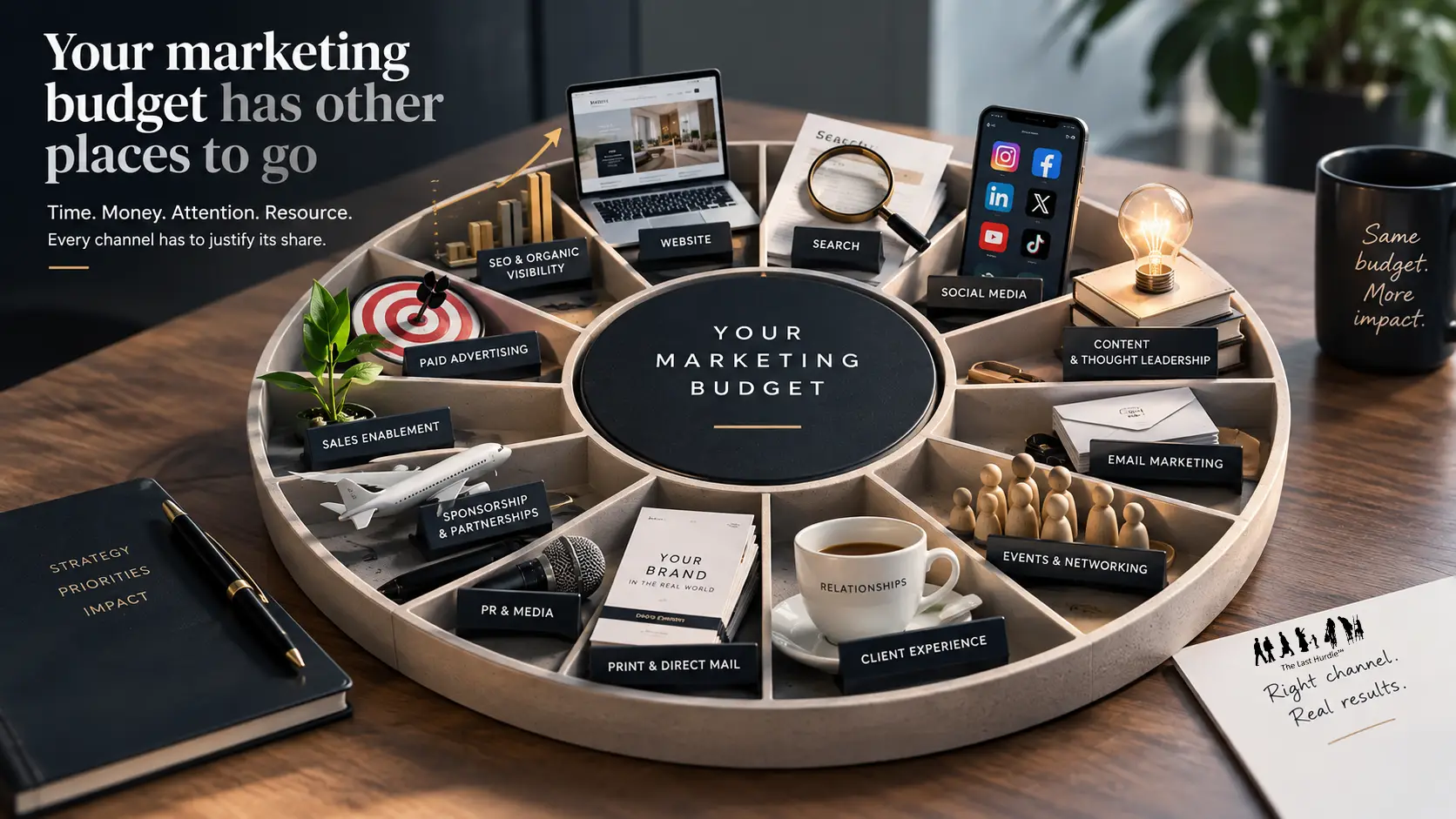
That £400 isn’t just competing with another social media subscription. It is competing with everything else in the marketing budget.
The same is true of the time required to manage a platform.
Those resources could go into the website, search, email marketing, content, AI visibility, social media, paid advertising, PR or events.
The easier it becomes to measure outcomes, the harder it becomes for any platform to rely on habit.
Social media can no longer mark its own homework
This is perhaps the biggest change.
For years, much of social media performance reporting came from the platforms themselves.
Reach. Impressions. Views. Followers. Engagement. Clicks.
Those numbers are useful, but they are not the whole story.
Businesses can now compare social reporting with much wider evidence.
Analytics can show what actually arrived at the website and what those visitors did next.
Search reporting can show how content is being discovered beyond the social platform itself.
Google has recently rolled out platform properties in Search Console, giving businesses greater visibility into how content published on Instagram, TikTok, X and YouTube is being discovered through Google Search, Discover and Google News.
AI visibility monitoring can now show which brands, websites and sources are being surfaced and cited within AI-generated responses.
CRM and enquiry data can show whether any of that attention eventually contributed to something commercially useful.
The platform dashboard is increasingly one piece of evidence rather than the verdict.
Which means:
“This post reached 8,000 people.”
is no longer the end of the conversation.
The next question is:
And then what happened?
Posting regularly is not a result
This is one of the easiest traps in social media marketing.
Activity looks productive.
The calendar is full. Three posts were published. Every platform was updated. The month’s content has been completed.
But a completed content calendar only proves that content was published.
It does not prove the marketing worked.
Businesses should be asking better questions:
- Is the platform sending relevant visitors to the website?
- Is it creating enquiries, introductions or useful conversations?
- Are the right people seeing the content?
- Is it helping maintain genuine professional relationships?
- Is it strengthening credibility or authority?
- Is the content contributing to visibility in search or AI-generated results?
- How much internal or agency time is required to make the platform work?
- What are we spending on advertising or subscriptions?
- Could that same time and money deliver more somewhere else?
But don’t judge every platform against the same measure.
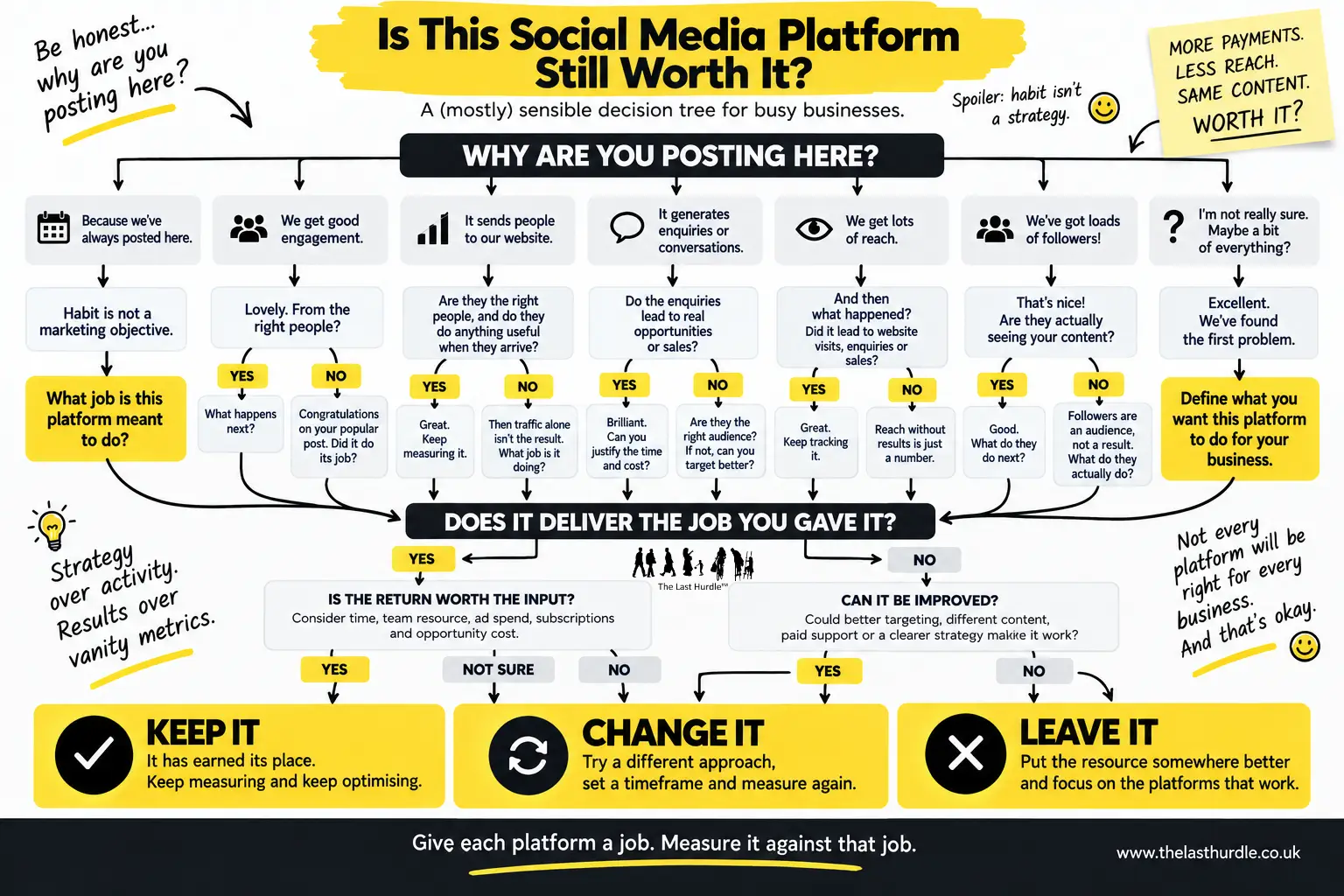
Give each platform a job and measure it against the job you gave it. If you can’t say what that job is, that’s probably the first thing you need to fix.
If Facebook is there to support an active community, website clicks may not be the right measure of success.
If Facebook is there to drive traffic to your website and nobody visits it, they absolutely are.
The same applies everywhere else.
Decide what you expect the platform to achieve. Look at what it has actually delivered over the last few months. Include the time and money required to maintain it.
Then decide whether to continue, change what you are doing or put that resource somewhere else.
Not every benefit will result in an immediate enquiry.
Not every useful interaction can be neatly attributed.
Brand awareness matters. Relationships matter. Visibility matters.
But those things should not become vague excuses used indefinitely to justify activity nobody has properly evaluated.
There should still be enough evidence to explain why the platform deserves continued investment.
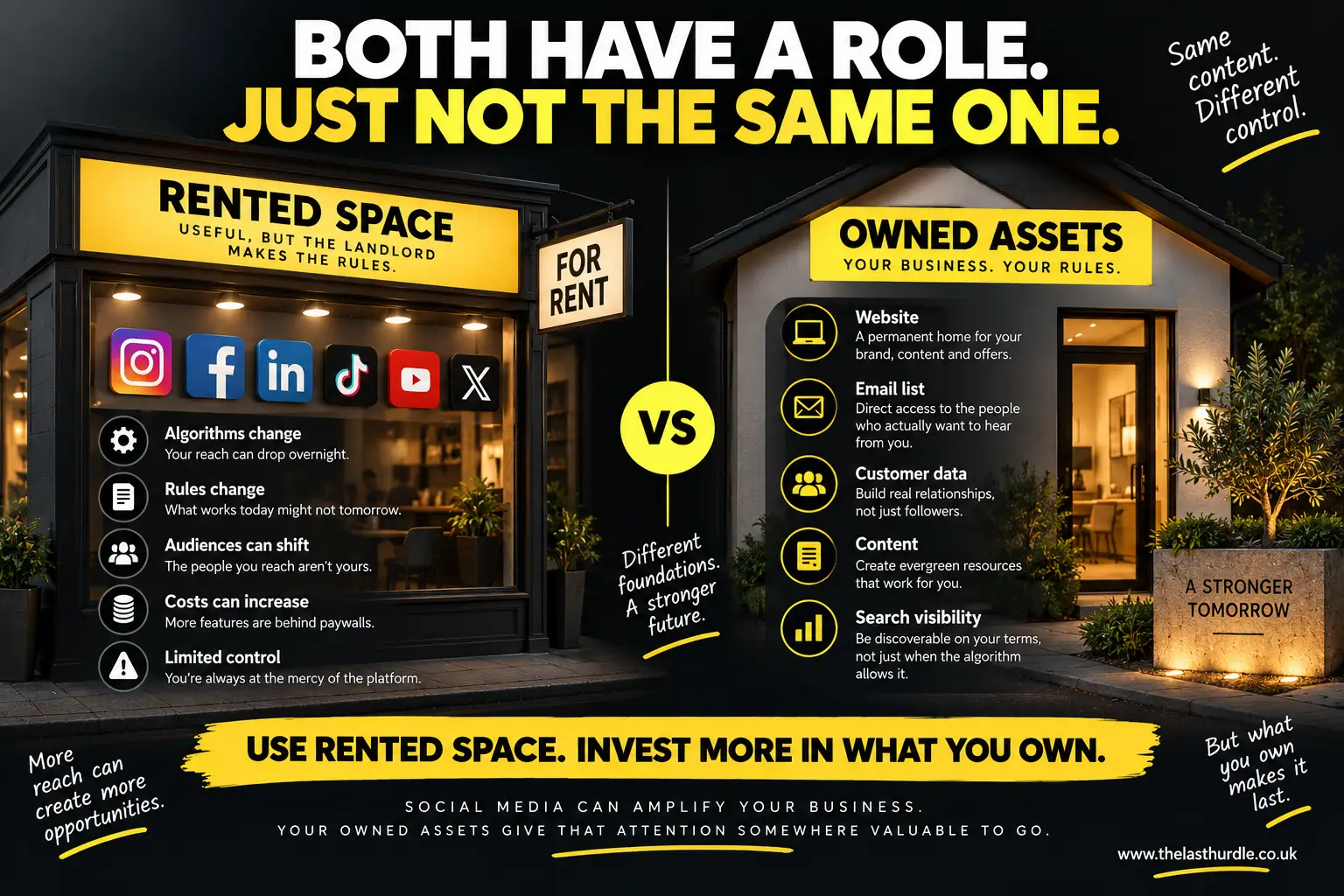
Your social audience is not really yours
Follower numbers can create a false sense of ownership.
A company may have spent ten years building an audience, but the platform still decides who sees its content, which posts appear in feeds, whether links can be shared, which features remain free, what businesses must pay for and whether the audience they have built can be reached at all.
Social media accounts are rented spaces.
That doesn’t make them worthless, but it does mean businesses should think carefully before becoming dependent on them.
Your website matters because it is an asset you control.
Your email database matters. Your content library matters. Your search presence matters. Your direct customer relationships matter.
Social platforms should support those assets.
They should not replace them.
Every platform must earn its place
Businesses do not need to remain on every social platform.
They do not need to continue posting simply because they have always done it.
The fact that you have spent years building a presence somewhere is not, on its own, a reason to spend another year maintaining it.
The correct decision could be to continue investing because a platform is delivering excellent results. It could be to reduce posting frequency, change the type of content, concentrate on relationship building or give the platform one clearly defined job.
It could be to invest more because the results justify it.
It could also be to move that resource somewhere else or leave completely.
What matters is that the decision is based on what the platform delivers now, not what it delivered three, five or ten years ago, how many followers have accumulated or what businesses were once told social media could achieve.
For years, businesses have adapted their marketing to accommodate the platforms.
Algorithms changed. Organic reach declined. Advertising increased. Formats changed. Features changed.
Businesses adapted.
They changed what they posted. They changed how often they posted. They created new formats, paid to reach audiences they had already built and invested more time trying to maintain the visibility and relationships the platforms once made easier.
But there comes a point when continually adapting to the platform is no longer good marketing strategy.
Sometimes the commercially sensible adaptation is to stop using it.
And that is the risk I think the platforms need to consider.
The question isn’t simply how many businesses they can persuade to pay for the next subscription, feature or piece of functionality.
It is how many times they can ask businesses to pay more, work harder or accept less before those businesses decide they no longer need the platform at all.
Because businesses have more evidence than ever before about what their marketing is actually delivering.
They can see the website traffic. They can see the enquiries. They can see the search visibility. They can measure the time. They can calculate the cost. And they can compare all of it with somewhere else that same resource could be spent.
Social media can no longer mark its own homework.
And it can no longer rely on businesses continuing to show up simply because they always have.
For years, businesses have adapted to the platforms.
Perhaps it is time the platforms started paying a little more attention to what businesses need from them.
Social media has nowhere left to hide behind follower counts, posting schedules and its own performance dashboards.
Every platform now has to earn its place in the marketing stack.
Part of the Marketing Clarity Series
This article is part of the Marketing Clarity series from The Last Hurdle, exploring the thinking behind clearer, more effective marketing.
Social media can still play an important role in a marketing strategy, but presence alone is not a result. The important questions are what each platform is there to achieve, what it actually delivers, what it costs in time and money, and whether that investment could work harder somewhere else.
Marketing Clarity is about asking those questions across your whole marketing mix, looking beyond activity and vanity metrics to understand what is genuinely helping your business achieve its goals.
👉 Explore the full Marketing Clarity series