
AI Search Jargon Explained
What Do GEO, AEO, AI Citations and All the Rest Actually Mean?
Just when most businesses had got reasonably comfortable with SEO, digital marketing acquired a whole new vocabulary.
AI search. AI visibility. AI citations. Mentions. Prompts. GEO. AEO. LLMO. AI Share of Voice.
Excellent. More acronyms.
Some of these terms describe genuinely new concepts. Some describe things that have existed in search marketing for years but are receiving renewed attention because of AI. Some overlap considerably. And some of the impressive-looking metrics appearing in AI visibility reports mean slightly different things depending on which platform produced them.
That last point matters.
AI search is developing quickly, and the language used to describe it is developing alongside it. There isn’t yet one universally agreed dictionary of AI search terminology. Two platforms can use the same term but measure it differently. Equally, two people can use different acronyms to describe activities that are remarkably similar.
Do you actually need to learn all of this? No.
You need enough understanding to know what people are talking about, particularly when somebody is reporting on your marketing performance, presenting you with an AI visibility score or trying to sell you an AI search service.
You don’t need to become an AI search specialist. But you should be able to ask what a metric means, how it’s being measured and whether two impressive-sounding terms are actually describing pretty much the same thing.
That’s what this guide is for.
So, rather than adding another layer of jargon, let’s translate it.
Making Sense of the AI Jargon
What is AI Search?
AI search is the use of generative AI as part of the process of finding information online.
The most obvious example is opening an AI assistant such as ChatGPT or Gemini and asking it a question.
Instead of typing a short search such as:
commercial boiler servicing Milton Keynes
you might ask:
Who provides commercial boiler servicing in Milton Keynes and can work on large commercial premises?
The AI then generates an answer rather than simply presenting a traditional list of search results.
However, AI search doesn’t only happen when someone deliberately chooses to use an AI assistant.
Someone can carry out what feels like a perfectly ordinary Google search and be presented with an AI-generated answer within the search results.
And that introduces an important distinction: users don’t necessarily know that they’re using AI search.
Google’s AI Overviews, for example, can appear when Google’s systems determine that an AI-generated response would add value beyond its traditional search results. Google also offers AI Mode, a more conversational search experience designed for questions that may require exploration, comparison or follow-up questions.
Google itself describes AI Overviews and AI Mode as generative AI features within Google Search.
AI search can also happen within other websites and digital platforms. AI-powered onsite search, product discovery tools and recommendation systems can allow people to ask natural-language questions, compare options or find information without visiting a traditional search engine or consciously choosing to use an AI assistant.
So, when we talk about the growth of AI search, we are not simply talking about people abandoning Google and heading over to ChatGPT.
A person may still think:
“I’ll Google it.”
Or they may simply use the search function on a website.
In either case, AI may be involved in retrieving, interpreting or presenting the information they receive.
AI search isn’t necessarily a separate destination. Increasingly, it can be part of the search and discovery experiences people are already using.
Source: Google Search Central – AI features and your website

What is AI Visibility?
AI visibility describes whether, and potentially how prominently, your business, brand, products, services or content appear within AI-generated answers.
Again, that doesn’t just mean:
“Does ChatGPT know about my business?”
AI visibility can occur within dedicated AI assistants such as ChatGPT, within generative AI features built into conventional search engines such as Google, or within websites and other digital platforms that use AI to help people search, discover, compare or select information, products and services.
In other words, AI visibility isn’t defined solely by where the search happens. It is about whether your business or information becomes part of the AI-assisted answer or discovery experience.
The question has shifted slightly from the traditional SEO question of:
Where does my webpage rank?
to questions such as:
Does my business appear in the answer at all?
What is it being associated with?
Is my website being used as a source?
Is the business being presented as a potential solution?
Those are related questions, but they aren’t the same thing.
AI visibility is also becoming something businesses can increasingly measure. Google has begun testing dedicated Search Generative AI performance reporting within Search Console, designed to give website owners greater insight into visibility across generative AI features including AI Overviews and AI Mode.
So, AI visibility itself isn’t simply a new metric invented by marketing software companies because they needed another dashboard.
However, an AI Visibility Score produced by an individual platform is a different matter. How that score is calculated depends on the platform, the prompts being tracked, the AI systems being measured and the methodology being used.
We’ll come back to that distinction because it crops up rather a lot in AI search measurement.
Source: Google Search Central – Generative AI performance reports in Search Console
AI Mentions, AI Citations and Recommendations: What’s the Difference?
These terms are frequently bundled together, but they describe different things.
What is an AI Mention?
An AI mention occurs when an AI-generated response names your business or brand.
For example:
“Marketing agencies operating in the area include The Last Hurdle and…”
The Last Hurdle has been mentioned.
At this stage, that’s all a mention tells us. Our business has appeared in the AI-generated response. It doesn’t necessarily mean our website was used as a source, cited or linked to.
But AI search is often conversational, so that first response may only be the beginning. The user might ask for more information about The Last Hurdle, compare the businesses mentioned, narrow their requirements or ask a completely different follow-up question.
As that conversation develops, a mention could lead to our website or content subsequently being cited or linked to, or the conversation could move away from us altogether.
That’s another reason mentions, citations and referral traffic shouldn’t be treated as interchangeable measurements. They can represent different stages within an evolving search journey.
What is an AI Citation?
An AI citation occurs when an AI-generated answer identifies or attributes information to a particular source.
That source could be your website, a particular page or article, or indeed a third-party source containing information about your business.
A citation may include a clickable link to the source, but citation and link aren’t necessarily interchangeable terms.
How sources are attributed and displayed varies between AI platforms and search experiences. Some make the source and link highly visible within or alongside the answer. Others present source information differently.
Google, for example, says that AI Overviews and AI Mode provide links to supporting webpages so users can explore the information further.
This distinction matters when interpreting AI visibility reports. If a platform records 200 citations to your business or website, you need to understand what that particular platform is counting as a citation rather than automatically assuming it means 200 prominent links to your website were presented to potential customers.
For example, an AI system answering a question about marketing strategy might use an article published on The Last Hurdle website as one of the sources supporting its answer.
In that situation, our content has been cited.
That doesn’t necessarily mean the AI has recommended The Last Hurdle as a marketing company.

What is an AI Recommendation?
A recommendation goes a stage further.
If somebody asks an AI system to suggest suitable businesses, products or services and your business is presented as an appropriate option, it has effectively been recommended within that response.
So:
Mention ≠ Citation ≠ Recommendation
Your business can be mentioned without your website being cited.
Your website can be cited as an information source without your business being recommended.
And your business could potentially be recommended using information gathered from sources other than your own website.
Semrush, for example, distinguishes between brand mentions and citations when analysing AI visibility and identifies situations where a brand is mentioned in an AI response but the brand’s own website isn’t cited as the source.
It sounds like a small distinction. It isn’t.
If somebody tells you that your business received 200 AI citations last month, it’s useful to understand exactly what happened 200 times before deciding what that number means.
Source: Semrush – Finding AI visibility gaps
Source: Google Search Central – AI features and your website
What is AI Referral Traffic?
This one is considerably less complicated.
AI referral traffic is traffic arriving at your website after someone clicks through from an AI platform or AI-generated search experience.
It helps to separate the stages:
Visible → Mentioned or cited → Clicked
A business can have AI visibility without receiving a click.
It can be mentioned without being cited.
Its content can be cited without generating referral traffic.
These are different events and therefore different measurements.
Whether one matters more than another depends entirely on what the business is trying to achieve.
We’ll resist disappearing down that particular rabbit hole here. It deserves a conversation of its own (watch out for future blogs).
What is a Prompt?
A prompt is simply the question, instruction or information someone gives to an AI system.
Despite the slightly technical-sounding name, there is nothing particularly mysterious about it.
If you type:
Recommend a marketing company in Northamptonshire that works with SMEs
that’s a prompt.
The interesting part from a search marketing perspective is that prompts can be considerably more conversational and specific than the short phrases we traditionally associate with keyword searches.
We’ve explored this changing search behaviour in more detail in our article, AI Users Aren’t Searching in Keywords.
Compare:
commercial boiler servicing Milton Keynes
with:
Who can service a commercial boiler in Milton Keynes and has experience working in large industrial premises?
The underlying need may be similar, but considerably more context has been supplied.
What are Prompt Tracking and Prompt Visibility?
As AI visibility tools have developed, businesses can now track selected prompts to see whether their brand appears in the resulting answers.
This is generally referred to as prompt tracking, while prompt visibility describes whether or how a brand appears for those tracked questions.
There is an important caveat.
A prompt is not simply the new version of a keyword, and prompt visibility isn’t the same as a Google ranking position.
Generative AI systems can produce different responses to the same or similar questions, and the process behind producing an answer may involve considerably more than matching the words the user typed.
Google, for example, explains that its AI search experiences can use a technique known as query fan-out, issuing multiple related searches across subtopics and data sources to help construct a response. In simple terms, the question you type may not be the only search the AI carries out to produce its answer.
So, if a visibility tool tells you that you “rank third for a prompt”, it’s worth understanding exactly what the platform means by that.
We have acquired some new terminology.
We haven’t acquired a fixed set of ten blue links à la Google in a different outfit.
Source: Google Search Central – AI search optimisation guide

What is AI Share of Voice?
AI Share of Voice is broadly an attempt to measure how much visibility your brand receives within AI-generated answers compared with competing brands.
The concept itself is easy enough to understand.
The measurement is where things become more interesting.
There is currently no single, universally standardised way of calculating AI Share of Voice.
One platform may concentrate heavily on the frequency of brand mentions. Another may incorporate how prominently the brand appears. Calculations may also depend upon the prompts selected, competitors included and AI platforms being monitored.
Semrush, for example, describes AI Share of Voice using brand mentions within AI responses relative to the total mentions received by competitors in the category.
HubSpot describes it in terms of how frequently and prominently a brand appears compared with competitors.
Both are describing AI Share of Voice.
They aren’t necessarily measuring precisely the same thing.
So, if a report tells you:
Your AI Share of Voice is 37%.
there are some perfectly reasonable follow-up questions:
37% of what?
Measured how?
Across which prompts?
On which AI platforms?
That doesn’t make AI Share of Voice a useless metric. It means the methodology matters.
A percentage does not become meaningful simply because somebody put a % sign after it.

What is AEO?
AEO stands for Answer Engine Optimisation.
Broadly, it means optimising information so systems that provide answers can understand, retrieve and present it effectively.
Importantly, AEO isn’t entirely a product of the current generative AI boom.
Search engines have been moving beyond simply providing lists of webpages for years. Featured snippets, knowledge panels, voice assistants and other answer-based search experiences all contributed to the development of Answer Engine Optimisation.
Generative AI has broadened the conversation considerably.
We’ve looked separately at why AEO has become necessary and why the underlying issue is often clarity rather than technology in Everyone’s Talking About AEO. But Why Is It Needed?
Today, AEO is frequently used when discussing visibility within systems such as ChatGPT, Gemini and other AI-powered answer engines as well as more traditional search experiences.
This is also where the terminology starts to overlap.
AEO, GEO and LLMO are sometimes presented as neatly separated disciplines.
In practice, the boundaries aren’t nearly as tidy.
Even Google now discusses AEO/GEO together when addressing misconceptions around optimisation for generative AI search.
So, if you’ve encountered three different articles confidently explaining three slightly different definitions of AEO, you haven’t necessarily misunderstood them.
The terminology is still settling.
Source: Google Search Central – Optimising for AI search
What is GEO?
GEO stands for Generative Engine Optimisation.
Broadly, GEO describes work intended to improve the visibility and representation of content within answers produced by generative AI systems.
Unlike some emerging AI marketing terminology, GEO has stronger provenance than you might expect.
The term was used in the academic paper GEO: Generative Engine Optimization, published in the proceedings of ACM KDD 2024. The researchers examined techniques intended to improve the visibility of content within responses produced by generative engines.
GEO isn’t simply an acronym somebody invented last Thursday before launching a new consultancy package.
However, that doesn’t mean everything currently being sold under the banner of GEO represents an entirely new branch of marketing.
There is considerable overlap with established SEO principles.
Is GEO Replacing SEO?
Google currently states that there are no additional technical requirements for appearing in its AI Overviews or AI Mode and recommends continuing to follow established SEO best practices.
Its more recent guidance goes further: from Google Search’s perspective, optimising for its generative AI search experiences remains part of SEO.
That doesn’t mean nothing has changed.
How information is discovered, assembled, presented and consumed is changing significantly.
But it does mean businesses should be wary of anyone suggesting that SEO is dead and an entirely new collection of mysterious GEO techniques must now replace everything that came before it.
SEO has apparently died again. It has remarkable stamina.
We’ve unpacked the wider “AI is killing SEO” argument in AI Isn’t Killing SEO But It Is Exposing Marketing Gaps.
Source: GEO: Generative Engine Optimization – ACM KDD 2024
Source: Google Search Central – AI features and your website
What is an LLM and What is LLMO?
LLM stands for Large Language Model.
This is established technical terminology rather than marketing terminology.
Without disappearing into a computer science lesson, an LLM is a type of AI model trained on very large amounts of data to recognise patterns in language and generate responses.
Large Language Models underpin many of the generative AI systems people now interact with.
LLMO stands for Large Language Model Optimisation.
That is a much newer marketing term.
It is generally used to describe work intended to improve how a business, brand or its content is discovered, understood or represented by systems powered by Large Language Models.
And if you’re now wondering:
Hang on. Isn’t that remarkably similar to GEO and AEO?
Yes.
There is considerable overlap between LLMO, GEO and AEO, and there isn’t currently a universally agreed definition giving each discipline an entirely separate territory.
Different platforms, agencies and commentators use the terms differently.
If you’re struggling to understand the precise difference between AEO, GEO and LLMO, it isn’t necessarily because you’ve missed something.
The industry itself doesn’t use all of these terms consistently.
For businesses, understanding that is arguably more useful than memorising three definitions and pretending the boundaries between them are fixed.
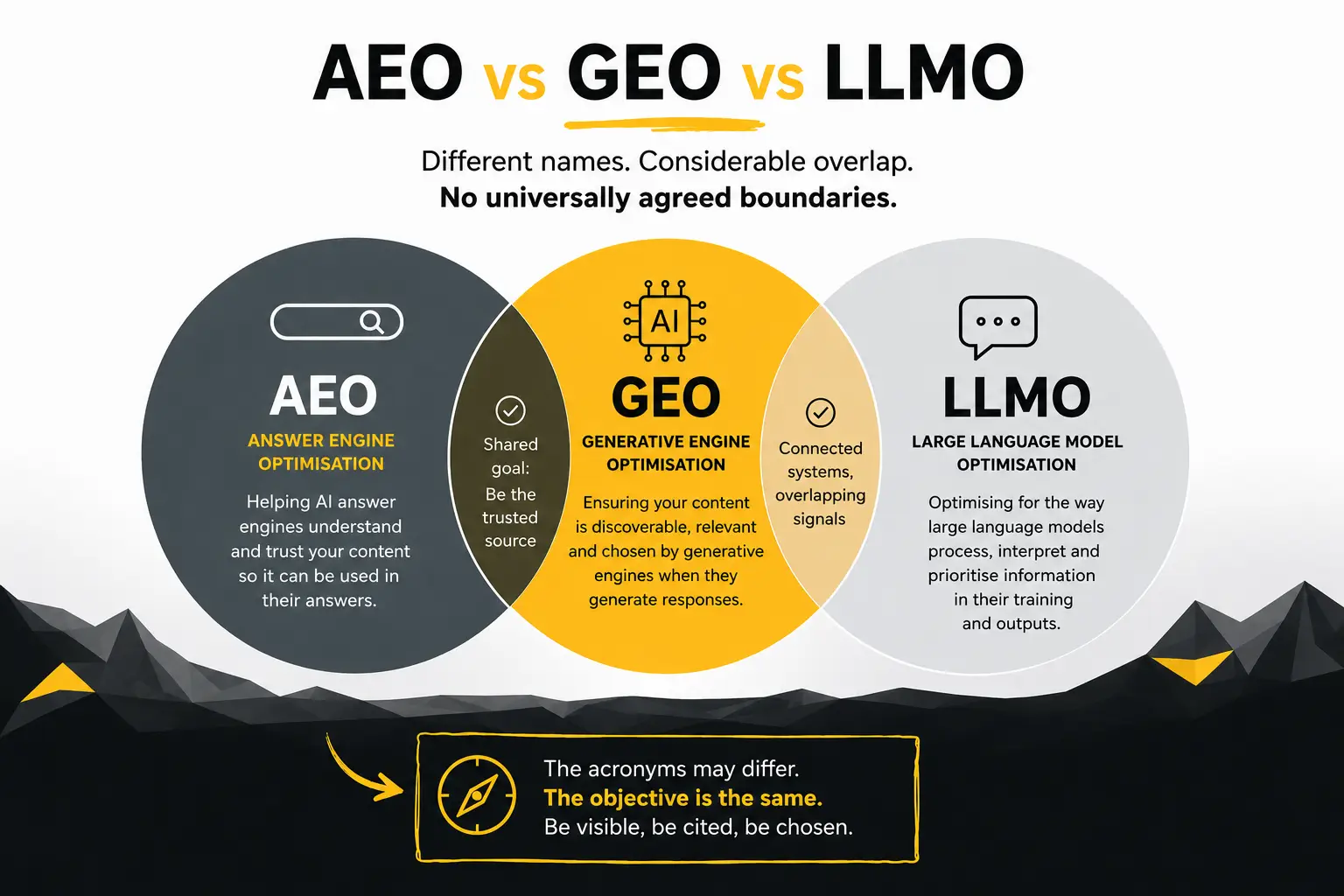
What’s the Difference Between AEO, GEO and LLMO?
There isn’t a universally agreed distinction.
Broadly, AEO focuses on visibility within systems that provide answers, GEO on visibility within generative AI responses, and LLMO on how brands and content are understood and represented by Large Language Model-powered systems.
In practice, there is considerable overlap between all three, and different platforms, agencies and commentators use the terms differently.
So, if somebody is selling these as three completely separate services, ask what work is actually included in each one.
What is an Entity?
An entity is a distinct person, organisation, business, place, product or other “thing” that a search system can recognise and connect with information.
For example, a search engine doesn’t have to interpret The Last Hurdle simply as three words appearing together on a webpage.
It can potentially understand The Last Hurdle as a particular business and associate that business with information such as its services, location, people, website and subject areas. In practical terms, you want search and AI systems to understand not just that your business exists, but what it does, where it operates and what subjects it is genuinely associated with.
The important thing to know here is:
Entities aren’t new AI terminology.
Entities and semantic search have been part of the SEO conversation for years.
They are receiving renewed attention because the ability of search and AI systems to understand relationships between businesses, people, products, subjects and sources is increasingly relevant to how information is retrieved and presented.
So, this is less:
“Here’s another new thing AI invented.”
and more:
“Here’s an existing search concept you’re going to hear about more often.”
But recognising an entity is only part of the picture. Search engines and AI also need enough information to understand what a business does, what it knows and how those things relate. If that information is missing or unclear, the digital picture of the business can be very different from the real one. We explore how to identify those gaps in Do Search Engines and AI Understand Your Business?
What are Grounding and RAG?
These sound far more technical than they need to for our purposes.
Grounding
Grounding means connecting an AI-generated response to external information rather than relying solely upon information contained within the underlying model.
RAG
RAG stands for Retrieval-Augmented Generation.
Put simply, a system retrieves relevant information and uses that information to help generate its response.
Why should a business owner care?
Because this helps explain why websites, useful content, crawlability, relevance, authority and many of the fundamentals associated with SEO haven’t suddenly stopped mattering.
Google explains that its generative AI search features use techniques including RAG and grounding to retrieve relevant, up-to-date information from webpages in its Search index, drawing upon its existing search and ranking systems.
In other words, the shiny new AI answer still needs information from somewhere.
Source: Google Search Central – AI search optimisation guide
What is Source Authority or Citation Authority?
This is an excellent example of why it’s worth understanding the difference between a concept and a standardised metric.
Source authority is a reasonably straightforward concept.
It refers broadly to the perceived relevance, reliability, expertise or authority of a source in relation to a particular subject.
You’ll also increasingly encounter phrases such as citation authority, sometimes accompanied by a score.
This is where we’d apply some caution.
There isn’t currently one universally accepted Citation Authority metric calculated in the same way across the AI search industry.
A particular visibility platform may create its own methodology for evaluating the perceived strength or importance of sources and call that Citation Authority, Citation Strength, Source Authority or something similar.
That doesn’t automatically make the metric meaningless.
But it does mean you should find out what it measures before treating the number as though it were an industry standard.
This is a recurring theme with emerging AI visibility measurement:
Understand the metric before admiring the score.
AI Search Jargon: Quick Reference
Term | What it means | How settled is the terminology? |
AI Search | Generative AI used as part of finding information | Established concept |
AI Visibility | Presence within AI-generated answers | Established/emerging measurement area |
AI Mention | A brand or business is named in an AI response | Established concept |
AI Citation | A source is identified or attributed within an AI response | Established concept; presentation varies |
AI Recommendation | A business, product or service is presented as a relevant option | Established concept |
AI Referral Traffic | Website visits originating from AI platforms or experiences | Established analytics concept |
Prompt | A question or instruction supplied to an AI | Established technical term |
Prompt Tracking | Monitoring AI responses against selected prompts | Emerging measurement practice |
AI Share of Voice | Relative AI visibility compared with competitors | Vendor-dependent measurement |
AEO | Answer Engine Optimisation | Older term with broader modern usage |
GEO | Generative Engine Optimisation | Emerging but increasingly established term |
LLM | Large Language Model | Established technical term |
LLMO | Large Language Model Optimisation | Emerging marketing terminology |
Entity | A recognisable person, business, product, place or other distinct thing | Established search concept |
RAG | Retrieval-Augmented Generation | Established technical term |
Grounding | Connecting AI output with external information | Established AI concept |
Citation Authority | A measure or concept relating to the perceived authority of cited sources | Non-standard/vendor dependent |
The Last Word
At the beginning of this guide, we said you don’t need to learn a whole new marketing language.
We meant it.
What you do need is enough understanding to make sense of what you’re being told.
If somebody presents you with an AI Visibility Score, you should be able to ask what went into it.
If your AI Share of Voice increased by 20%, you should be able to ask what was measured, across which prompts and against which competitors.
And if you’re told that your business urgently needs AEO, GEO and LLMO, it’s entirely reasonable to ask what each of those services actually involves and where one ends and the next begins.
There are three useful questions to keep coming back to:
What does this term actually mean?
How is this metric being calculated?
Is this genuinely something new, or an established search and marketing principle with a new name?
Some of the terminology we’ve covered describes genuinely new developments in search.
Some describes established concepts being applied in a new environment.
Some is still evolving.
And some metrics that look remarkably precise on a dashboard depend entirely on how the company behind that dashboard has chosen to calculate them.
The emergence of AEO/GEO doesn’t mean that everything we know about SEO can now be cheerfully thrown in the bin either.
Google’s own guidance says its generative AI search features remain rooted in its existing Search systems and that foundational SEO best practices continue to matter.
Search is changing. How people ask questions is changing. How answers are assembled and presented is changing. And businesses absolutely need to understand what that means for being found online.
But they don’t need to become AI search specialists to do that.
They need enough clarity to understand what they’re being shown, what they’re being sold and what questions they should be asking.
And once we understand what AI citations, mentions, visibility and Share of Voice actually measure, there’s a much more important question to ask:
Are we measuring these things simply because we can, or because they actually matter to the business?
That’s where we’ll go next.
Part of the Marketing Clarity Series
This article is part of the Marketing Clarity series from The Last Hurdle, exploring the thinking behind clearer, more effective marketing.
From visibility and customer journeys to AI discovery and communication friction, the series looks at how people find, understand and build confidence in businesses.