
AI Users Aren’t Searching in Keywords
One of the most interesting insights from Semrush’s recent ChatGPT traffic study was that 65–85% of prompts do not resemble traditional search behaviour.
For many marketers, that statistic signals the rise of AI search.
For me, it signals something slightly different.
I think we are witnessing a regression back toward natural human communication.
Because the reality is, people were never naturally searching in keywords to begin with.
Search engines trained them to.
Search Engines Trained Users to Search Unnaturally
I built my first website in 1998, long before SEO became the structured industry it is today.
And by around 2004, I was already experimenting with website optimisation techniques that, at the time, worked remarkably well.
Back then, ranking websites was often less about communication and more about matching patterns.
The internet was filled with tactics that would now be considered black hat SEO:
- hidden text
- excessive keyword repetition
- invisible location stuffing
- pages written almost entirely for search engines rather than people
You would see websites repeating phrases like:
“skip hire milton keynes”
“best skip hire milton keynes”
“cheap skips in milton keynes”
Sometimes hundreds of times on a single page.
And it worked.
Not because it was genuinely useful, but because early search engines relied heavily on pattern matching and keyword signals.
Over time, search engines became smarter.
Google improved its understanding of intent.
Predictive search accelerated shorter queries.
Users learned faster ways to search.
Instead of typing:
“Where can I hire a skip in Milton Keynes?”
People learned to type:
“skip hire milton keynes”
Not because that was natural communication.
Because it was efficient communication within the limitations of search engines.
And that shaped how websites were written too.
Many of us working in SEO spent years trying to awkwardly force unnatural wording into otherwise normal content because that was what ranked.
We would sit there carefully trying to make repetitive keyword phrases sound grammatically acceptable enough to pass approval processes, while also trying not to make the business sound completely unprofessional to actual visitors reading the page.
In many ways, entire generations of websites became mechanically written.
Not necessarily because businesses wanted poor communication, but because search engines rewarded optimisation patterns over natural explanation.
Pages became structurally optimised but communicatively weak.
Businesses learned how to sound optimised.
Not necessarily how to communicate clearly.
And many websites survived purely because they ranked well enough, not because they genuinely explained themselves well.
Businesses learned how to sound optimised. Not necessarily how to communicate clearly.
And perhaps that is one of the reasons clear content is increasingly being rewarded again as search evolves toward understanding rather than simple keyword matching.
AI Search Removes That Limitation
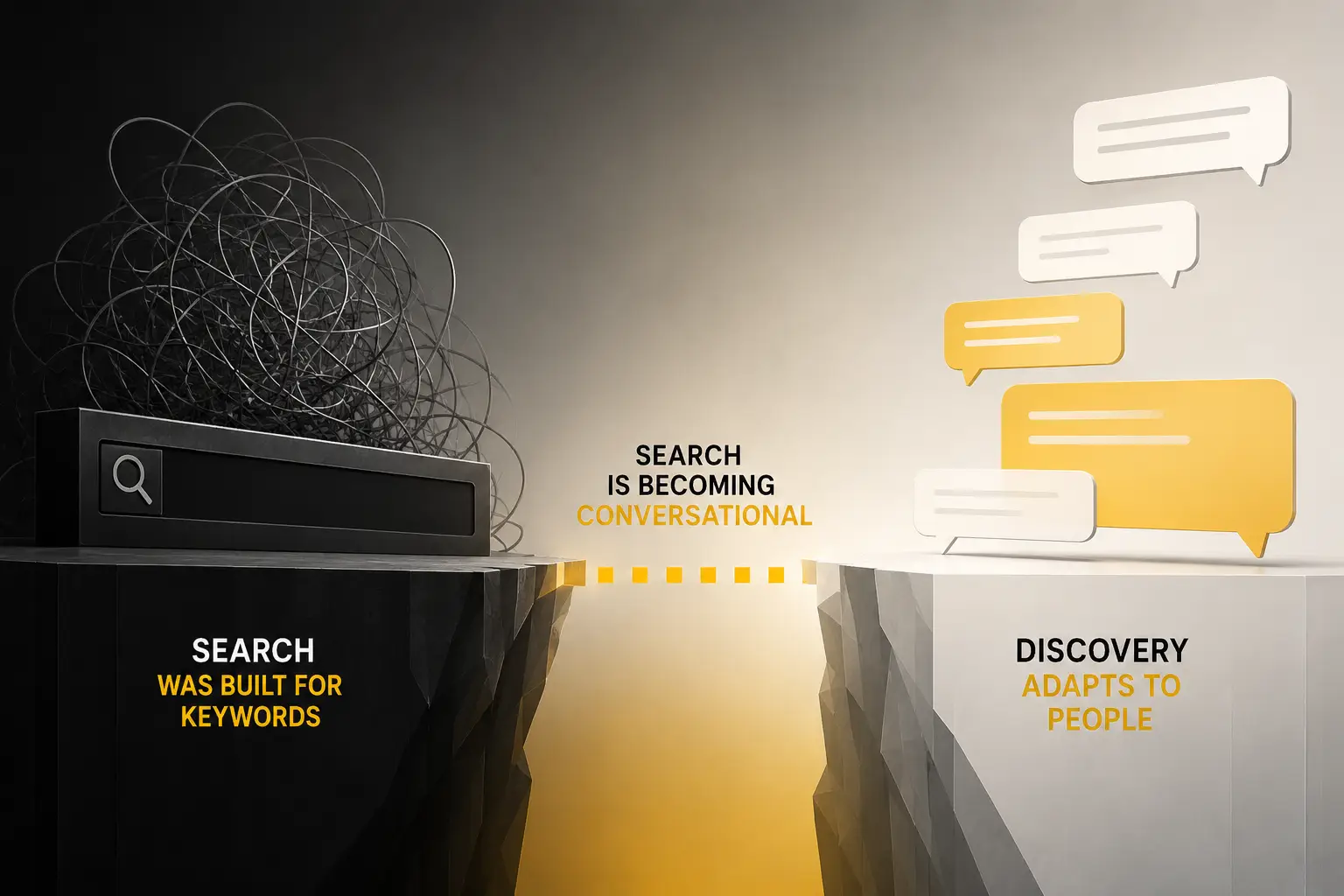
What makes AI search different is that users no longer need to compress their thoughts into fragmented search phrases.
They can communicate naturally.
And perhaps more importantly, they can continue the conversation.
That changes everything.
A traditional search journey might once have looked like this:
“bed bug treatment near me”
But AI-driven discovery increasingly looks far more conversational, contextual, and iterative.
Someone might upload a photograph and ask:
“What on earth is this I’ve just found in my bed?”
The AI identifies it as a possible bed bug and explains why.
The user then asks:
“How serious is this?”
Then:
“Can I get rid of these myself?”
Then:
“What signs should I look for?”
Then:
“I’ve noticed small marks on the mattress and bites on my arms.”
The conversation continues.
The AI explains how bed bugs spread, where they hide, why DIY treatment often fails, how quickly infestations escalate, and why professional treatment is usually required.
The user then asks:
“Who deals with this near me?”
At that point, the AI may begin surfacing local pest control businesses, review platforms, websites, service pages, and business information directly within the conversation itself.
And increasingly, these AI-generated responses are also appearing directly within traditional organic search results.
Google’s AI Overviews are now introducing conversational-style answers directly into search journeys before users even click through to websites.
Which means users are no longer simply typing isolated keywords into a search engine.
They are having ongoing, layered conversations around a problem.
That is an important distinction.
Because this is not just a longer search query.
It is a progressive discovery journey built around:
- context
- follow-up questions
- reassurance
- explanation
- trust
- intent refinement
- local recommendations
- conversational understanding
In many ways, this is actually a continuation of a behavioural shift that started years ago with voice assistants and voice search.
When users spoke to Alexa, Siri, or Google Assistant, they naturally became more conversational:
- “Where’s the nearest petrol station?”
- “What time does Tesco close?”
- “Do I need planning permission for an extension?”
Voice search began reversing the unnatural keyword behaviour traditional search engines had trained into users.
AI simply completes that progression.
Because users are no longer just asking a single question.
They are exploring an entire situation through conversation.
And that changes what good optimisation looks like completely.
AI Search Is Rewarding Understanding
This is why I believe many businesses are misunderstanding AEO (Answer Engine Optimisation).
AEO is not simply:
- adding FAQ schema
- rewriting pages with “AI keywords”
- producing more content faster
It is about making your business easier to understand.
Because AI systems are increasingly selecting and recommending businesses based on clarity.
Can the system confidently determine:
- what you do
- who you help
- what problem you solve
- whether your information is trustworthy
- whether your explanation is easy to follow
If the answer is unclear, vague, bloated, or hidden behind industry jargon, both users and AI systems struggle.
And in many ways, AI search is exposing weaknesses that already existed.
Not just weak SEO.
Weak communication.
Businesses relying on vague positioning.
Businesses saying a lot without explaining very much.
Businesses hiding behind inflated marketing language instead of clearly explaining their value.
Because if a business cannot explain itself simply and clearly to a customer, AI systems are unlikely to interpret that value confidently either.
AI is not creating those problems.
It is revealing them faster.
SEO and AEO Are Not Separate Conversations
One of the biggest mistakes currently happening in marketing is treating AEO as though it replaces SEO.
It does not.
Technical SEO still matters.
Site structure still matters.
Authority still matters.
Content relevance still matters.
But AI-driven discovery places increasing emphasis on:
- clarity
- understanding
- contextual relevance
- conversational intent
- confidence in answers
Which means the businesses likely to succeed are often the ones communicating most clearly rather than the ones sounding most “optimised”.
That is a significant shift.
Because for years, many websites were written primarily to rank.
Now they increasingly need to be written to explain.

What This Means for SME Businesses
For many small to medium-sized businesses, AI search can feel like another intimidating marketing shift filled with technical terminology and conflicting advice.
But the underlying principle is actually quite simple.
Businesses that communicate clearly are becoming easier to discover.
That applies across:
- websites
- service pages
- Google search
- AI Overviews
- ChatGPT recommendations
- voice search
- local discovery
Because modern search is increasingly built around understanding rather than just matching phrases.
That means businesses need to think more carefully about:
- whether their services are explained clearly
- whether their website answers real customer questions
- whether their messaging reflects how customers actually think
- whether trust signals are visible
- whether users can quickly understand what makes the business different
Increasingly, businesses need to create websites and content that answer questions before customers even realise they need to ask them.
Many SME websites still rely heavily on internal terminology, vague marketing language, or assumptions that customers already understand the service being offered.
But customers rarely arrive with the same knowledge the business has.
And AI systems do not automatically “fill in the gaps” either.
If a business is difficult to understand, difficult to navigate, or difficult to interpret confidently, that affects both human users and AI-driven discovery.
And sometimes the problem goes further than clarity. The business may genuinely have the expertise, services and experience, but its digital presence simply doesn’t demonstrate them. We explore how to identify the difference between what a business actually knows and does and what customers, search engines and AI can see in Do Search Engines and AI Understand Your Business?
This is why clarity is no longer just a branding exercise.
It is increasingly becoming part of visibility itself.
The businesses likely to perform best over the next few years may not necessarily be the loudest.
They may simply be the clearest.
AI May Push Marketing Back Toward Better Communication
Ironically, AI search may improve marketing overall.
For years, businesses became obsessed with:
- keyword density
- algorithm chasing
- awkward optimisation tactics
- writing for rankings first and users second
And now we are seeing the same behaviour beginning to emerge around AI.
Businesses rushing to mass-produce AI-generated blogs.
Marketers searching for “AI SEO hacks”.
Websites flooding themselves with content clearly written to game systems rather than genuinely help users.
In many cases, it is simply the same optimisation mindset wearing different clothes.
But AI systems work differently.
They favour content that helps them understand something properly.
Which means genuinely useful communication becomes more valuable again.
Not inflated wording.
Not jargon-heavy explanations.
Not pages trying desperately to sound authoritative while saying very little.
Just clear communication.
And perhaps that is where marketing should have been focused all along.
The Last Word
Semrush’s study highlights an important shift in search behaviour.
But I do not believe AI is fundamentally changing how humans communicate.
I think it is removing the limitations that forced them not to.
For years, users adapted themselves to search engines.
Now search engines are adapting themselves to users.
And that changes what optimisation looks like.
Because visibility is increasingly tied not just to keywords, but to clarity, understanding, context, and trust.
The businesses most likely to succeed in AI-driven discovery may not be the ones trying hardest to optimise.
They may simply be the ones easiest to understand.
Part of the Marketing Clarity Series
This article is part of the Marketing Clarity series from The Last Hurdle, exploring the principles behind marketing that works.
The series helps UK SMEs better understand how customer behaviour, SEO, AEO, and business communication are evolving in an increasingly AI-driven digital landscape.