

How Often Should You Update Your Website?
The short answer?
It depends.
What, you wanted a number?
“Every month.”
“Every six months.”
“Every Tuesday after lunch.”
Unfortunately, there isn’t a universal answer.
The right frequency depends on your business, your objectives and the role your website plays in helping you achieve them.
Some businesses only need to make a handful of meaningful updates each year. Others benefit from improving their website every week.
Rather than following an arbitrary schedule because someone on the internet told you to, it’s far more valuable to understand what should trigger an update in the first place.
In short: There isn’t a schedule you should follow. Update your website when you’ve identified an opportunity to improve it.
Before asking how often you should update your website, ask yourself something much more important.
What do you actually need your website to do?
For some businesses, a website is simply there to reassure potential customers they’ve found the right company and make it easy to get in touch.
For others, it has a much bigger job.
Perhaps you expect it to:
- Generate enquiries.
- Rank well in search engines and AI answer engines.
- Explain complex products or services.
- Support your sales process.
- Recruit new employees.
- Demonstrate expertise.
- Build trust before someone makes contact.
Those are very different objectives.
Naturally, they’ll require different levels of attention.
The more important your website is in achieving your business goals, the more actively it should be developed.
There is no “correct” update schedule.
There is only the schedule that’s right for what your website needs to achieve.
Is It Doing Its Job?
Now take an honest look at your website.
Ask yourself:
- Is it generating the enquiries you hoped it would?
- Can visitors immediately understand what you do?
- Are people finding the information they’re looking for?
- Is your website visible when people search for your services?
- Does it answer the questions customers ask before making contact?
- Does it reflect your business today?
If the answer is yes…
Wonderful.
Don’t start changing things simply because someone tells you that you should be updating your website every month.
If the answer is no…
Now you have a reason to make changes.
Every update should solve a problem or move you closer to one of your business objectives.
Updating your website isn’t about keeping busy.
It’s about making it work harder.
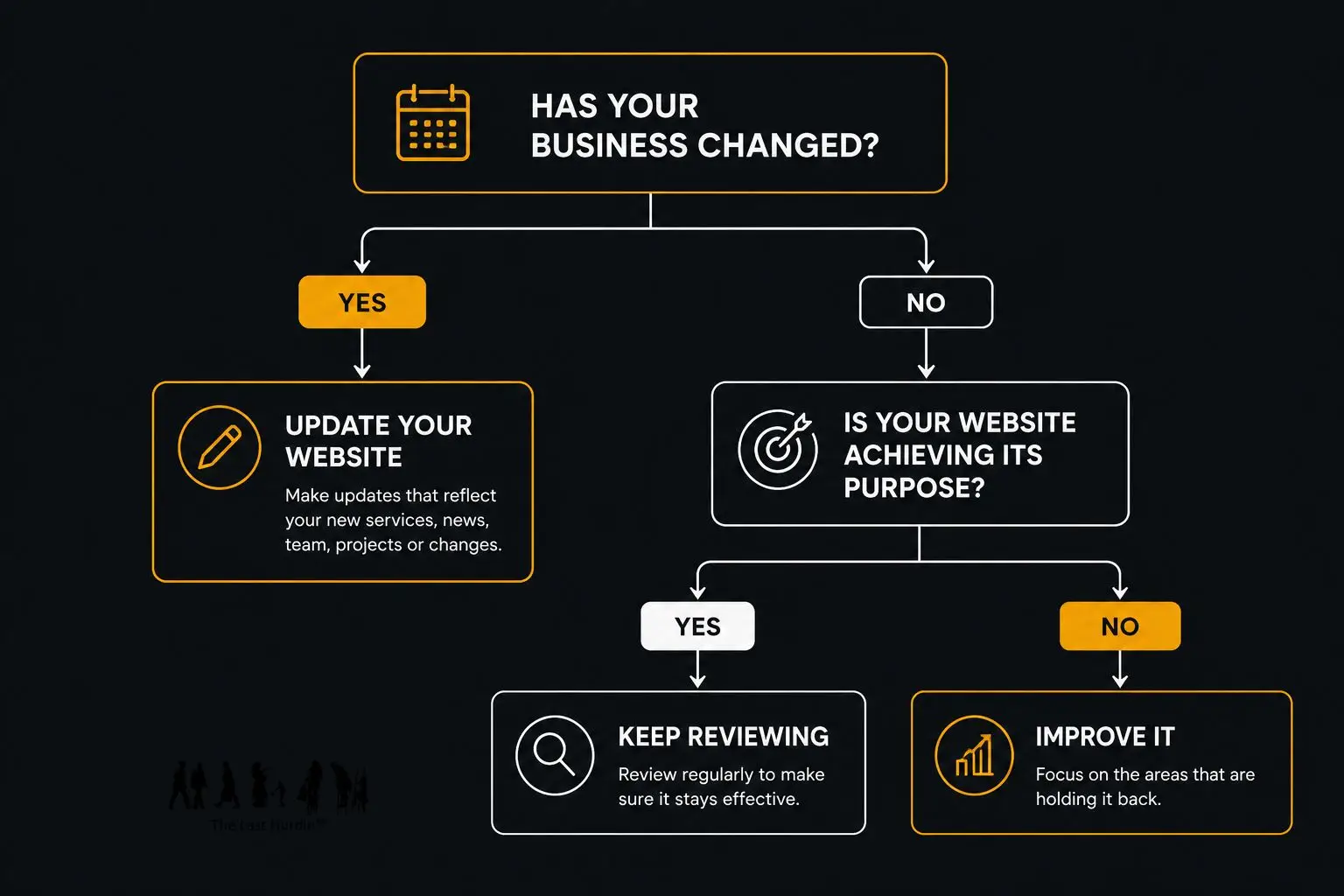
Has Your Business Changed?
Businesses rarely stand still.
Neither should their websites.
Think about how your business has changed over the past year.
Perhaps you’ve:
- Introduced a new service.
- Stopped offering an old one.
- Changed your ideal customer.
- Expanded into new sectors.
- Opened another location.
- Invested in new equipment or technology.
- Won an award or accreditation.
- Completed an interesting project.
- Added new team members.
- Received fantastic customer feedback.
- Refined the way you work.
- Increased your prices.
- Specialised in a particular area.
Each of those changes is an opportunity to improve your website.
Keeping your website aligned with your business helps visitors understand exactly who you are today, not who you were three years ago.
It also gives search engines and answer engines more accurate information about your business.
Most importantly…
It prevents potential customers making decisions based on outdated information.

Is Your Existing Content Still Working?
One of the biggest misconceptions about website updates is that they always involve creating something new.
In reality, some of the biggest improvements come from refining what already exists.
Before writing another blog or adding another page, review your existing content.
Ask yourself:
- Is it immediately obvious what we do?
- Is it clear who we help?
- Have we explained the benefits, not just the features?
- Are we answering the questions customers actually ask?
- Is there anything visitors might misunderstand?
- Do people understand what happens after they contact us?
- Would someone completely new to our business know why they should choose us?
Then look for opportunities to improve.
Perhaps you could:
- Expand a thin service page.
- Add FAQs.
- Include a recent case study.
- Replace outdated photographs.
- Add testimonials.
- Improve your calls to action.
- Link related pages together more effectively.
Refreshing an existing page is often more valuable than publishing a brand-new one.
Do You Have Something Worth Sharing?
Not every website update needs to be driven by your business.
Sometimes it should be driven by your customers.
Think about the conversations you’ve had recently.
What questions keep coming up?
What misconceptions do you find yourself correcting?
What do customers struggle to understand before they buy?
What have you learnt recently that could genuinely help someone else?
Those questions often become your best content.
The goal isn’t simply to publish more blogs.
It’s to create content that helps people make better decisions.
When your website consistently answers the questions your customers are already asking, it becomes far more valuable, for both your visitors and search engines.
Can You Sustain It?
It’s easy to create an ambitious content plan.
It’s much harder to stick to one.
There is little value in promising yourself a new article every week if the reality of running your business means you give up after a month.
A realistic schedule that you can maintain is almost always more effective than an ambitious one that quickly falls apart.
Consistency builds trust.
Consistency builds authority.
Consistency builds momentum.
Choose a pace that works for your business.
Then keep going.
Don’t Forget The Technical Side
Throughout this article we’ve focused on the updates your customers actually experience.
There is, however, another type of update that’s just as important.
Technical maintenance.
This includes:
- Updating your content management system.
- Updating plugins and themes.
- Running and verifying backups.
- Applying security patches.
- Monitoring website performance.
Your customers may never notice these updates.
They’ll certainly notice if your website becomes slow, insecure or stops working altogether.
Think of technical maintenance as protecting everything else you’ve invested in.
It won’t usually generate enquiries on its own, but it helps ensure your website remains secure, reliable and available when your customers need it.
So, How Often Should You Update Your Website?
There isn’t a magic number.
Instead, use these simple principles.
Update your website whenever your business changes.
If you’ve introduced a new service, completed an exciting project or changed the way you work, your website should reflect it.
Review your most important pages regularly.
Ask whether they’re still explaining your services clearly and answering the questions your customers ask today.
Create useful content consistently.
Don’t chase arbitrary publishing schedules.
Publish when you have something genuinely useful to say and choose a pace you can sustain over the long term.
Maintain the technology behind your website.
Regular maintenance protects everything else you’ve invested in.
The Last Word
Your website isn’t a project you finish.
It’s a business asset.
Like every valuable asset, it needs looking after.
Not because someone told you to update it every month.
Not because you’ve read that Google prefers “fresh content.”
Not because you feel guilty that you haven’t written a blog recently.
Update your website because your business has changed.
Improve it because your customers need more.
Review it because it has stopped achieving the purpose you built it for.
Start with your business objectives.
Then make the changes that help you achieve them.
That’s far more valuable than following an arbitrary schedule.
Need A Little Clarity?
Every business has different objectives, which means every website should too.
If you’re unsure whether your website is helping your business achieve its goals, we’d be happy to review it with you.
We’ll review how well it’s supporting your objectives, identify opportunities for improvement and help you prioritise the changes most likely to make a measurable difference.
Because updating a website isn’t about ticking boxes.
It’s about building a website that works harder for your business.