
Before You Block AI Crawlers, Make Sure You Understand What You Are Giving Up
AI – To Block or Not to Block? More businesses are asking the question, but many are missing the bigger commercial implications.
Businesses are increasingly discussing whether they should block AI crawlers from accessing their websites.
Some see AI platforms as an opportunity for visibility and discovery. Others see them as a threat to content ownership, traffic and attribution. In response, more businesses are experimenting with blocking AI bots through robots.txt, firewalls, CDNs and bot management tools.
The concern is understandable.
But there is also a growing risk that businesses make reactive decisions without fully understanding what they may also be blocking in the process.
Because this conversation is no longer just about model training.
It is increasingly about visibility, discoverability and whether AI-driven search tools can meaningfully understand and reference your business in the future.
And in some cases, businesses may already be limiting AI access accidentally without even realising it.
Should Businesses Block AI Crawlers?
Businesses should not automatically block or allow AI crawlers. The right decision depends on visibility goals, content strategy, commercial model and how important AI-driven discovery may become for the business.
Most conversations around AI crawlers quickly become about protection and risk. But there is another side to the discussion that businesses should not ignore: visibility.
Blocking AI crawlers is not automatically the wrong decision.
For some organisations, restricting AI access may align perfectly with their commercial model, legal obligations or content strategy.
Examples may include:
- Premium or subscription-based publishers
- Proprietary research providers
- Licensed or regulated content environments
- Businesses concerned about content reproduction or attribution
- Organisations with privacy or compliance sensitivities
- Websites experiencing excessive server load from automated crawling
There are also understandable concerns around how AI models use and process publicly accessible information.
This article is not arguing that every business should allow unrestricted AI access.
The important point is that businesses should understand the trade-offs before making visibility decisions that could affect discoverability in the future.
What Happens If You Block AI Crawlers?
Blocking AI crawlers may reduce the likelihood of your business appearing in AI-generated summaries, recommendations and conversational search results.
The discussion around AI crawlers is often framed purely as a protection issue.
But for many businesses, there is also a visibility conversation taking place at the same time.
AI-driven search, conversational interfaces and answer engines are increasingly shaping how people discover information, compare providers and evaluate services. This shift is part of a much wider change in digital behaviour, something we explored further in our article on why everyone is talking about AEO, but very few are talking about why it is needed.
That means businesses are no longer only competing for rankings inside traditional search engines.
They are increasingly competing for inclusion inside AI-generated responses, summaries, recommendations and citations.
Increasingly, users are not simply searching and clicking in the traditional sense. They are asking questions, requesting summaries and seeking recommendations directly from conversational AI platforms. This behavioural shift is something we explored further in our article on why AI users are not searching in keywords, where we looked at how conversational discovery is changing the way businesses need to think about visibility and communication.
That behavioural shift is part of why AI visibility is becoming commercially relevant for many businesses.
If retrieval systems cannot meaningfully access your content, they become far less likely to:
- Reference your expertise
- Surface your services
- Recommend your business
- Summarise your content
- Associate your brand with relevant topics
- Understand the problems you solve
This is particularly important for:
- Service businesses building authority
- Local businesses relying on discovery
- Ecommerce businesses seeking product visibility
- Businesses competing in comparison-driven sectors
- Companies investing in Answer Engine Optimisation (AEO)
For example, a local engineering company, consultancy or specialist contractor may still rank well in traditional search results, but if conversational platforms struggle to interpret or access their content, they may become far less visible inside AI-generated recommendations and answer-driven search experiences.
Visibility is evolving beyond simple keyword rankings.
And while AI visibility is not identical to SEO, the two are becoming increasingly interconnected.
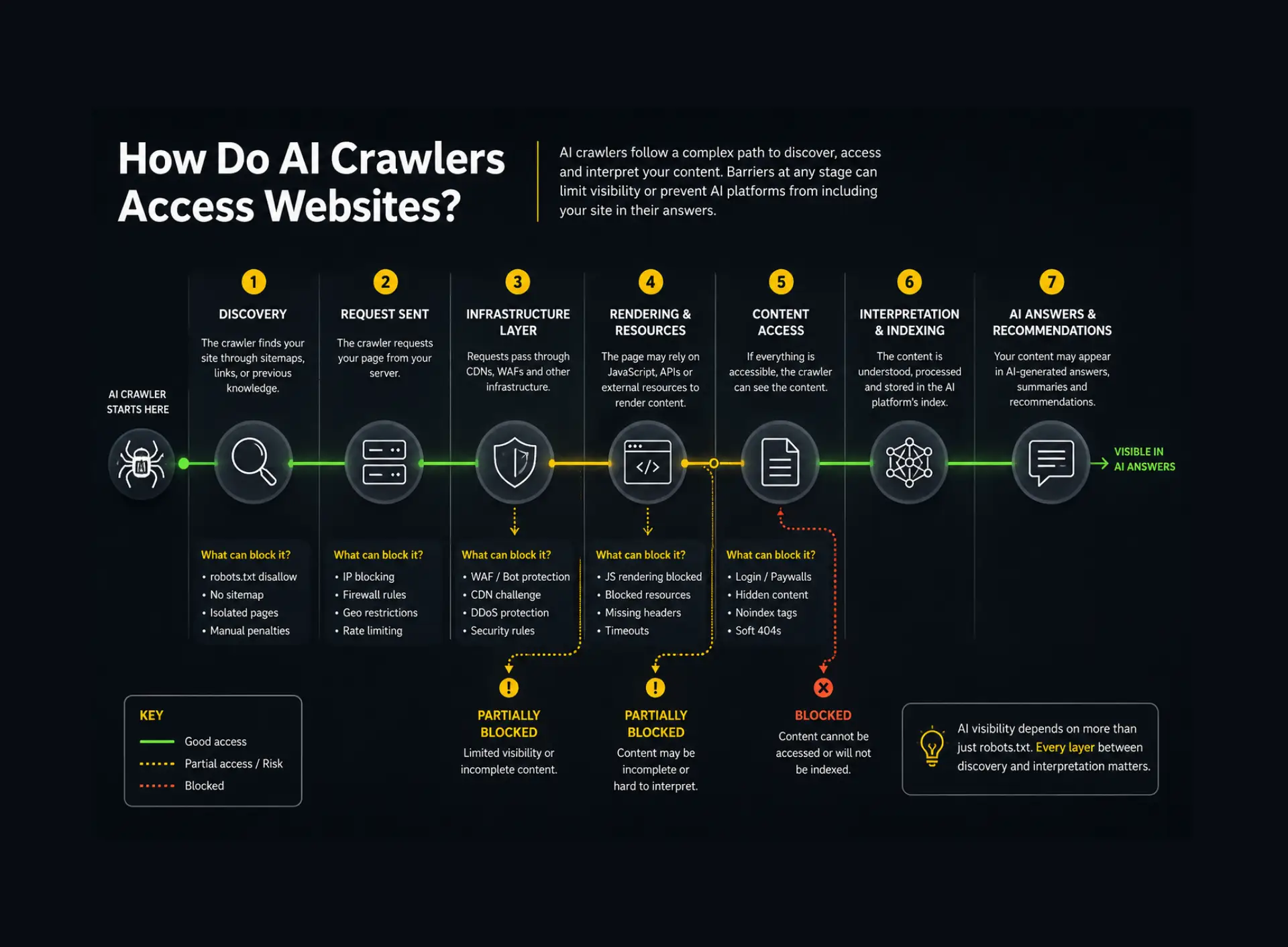
How Do AI Crawlers Access Websites?
AI crawlers access websites in similar ways to traditional search engine bots, but modern website infrastructure can unintentionally create barriers that affect crawlability, rendering and machine understanding.
When businesses think about blocking AI crawlers, robots.txt is usually the first thing that comes to mind.
But AI accessibility is often affected by far more than a single file.
In practice, this often happens through tools designed to improve website security or performance — sometimes without businesses realising those systems may also affect AI visibility.
Modern websites sit behind layers of infrastructure, security and optimisation systems that can unintentionally prevent retrieval systems from accessing or understanding content properly.
This can include:
- Web Application Firewalls (WAFs) that treat unfamiliar crawlers as suspicious traffic
- Bot management systems that aggressively rate limit or challenge AI user agents
- CDNs that present JavaScript or browser verification steps a crawler cannot complete
- Geo restrictions, IP reputation filtering or ASN blocking
- Cookie consent overlays or login walls that interrupt access to meaningful page content
- Heavy client-side rendering where the visible content only appears after scripts run
- Redirect chains that fail or loop for non-browser agents
- Lazy-loaded or dynamically injected content that never becomes visible to the crawler
One of the biggest problems is that many businesses assume AI platforms can access their website simply because they never intentionally blocked them.
In reality, AI access can fail quietly through:
- security plugins
- CDN settings
- aggressive bot filtering
- rate limiting
- JavaScript-heavy rendering
- browser verification systems
In some cases, pages technically load while the meaningful content never becomes visible to the crawler.
The result is not necessarily a completely inaccessible website.
It is often partial visibility, incomplete understanding or reduced discoverability — and many businesses may never realise it is happening.
A website can appear completely functional to a human visitor while remaining difficult for AI-driven retrieval systems to properly interpret.
That matters because if those systems cannot consume your content reliably, they are significantly less likely to surface, reference or recommend it.

How Can You Tell If AI Platforms Can Access Your Website?
There is currently no perfect “AI visibility dashboard” that tells businesses exactly what every AI platform can or cannot access.
But there are practical ways to identify obvious problems.
Review Your Access Logs
One of the most useful starting points is reviewing server access logs for known AI crawlers and user agents.
Examples may include:
- GPTBot
- ClaudeBot
- PerplexityBot
- Google-Extended
- Bytespider
- Amazonbot
Look for patterns such as:
- 403 responses
- 429 rate limiting
- challenge pages
- failed rendering attempts
- unusually low crawl activity
And importantly, if AI crawlers never appear at all, that can also be a signal worth investigating.
Ask The AI Platforms Directly
One of the simplest visibility tests is to ask the AI tools themselves.
Instead of asking broad questions like:
“What does this company do?”
Ask highly specific questions that require the platform to retrieve meaningful information from your website.
For example:
- “What does [company] offer for [specific use case]?”
- “Summarise the key points from [exact URL].”
- “Which page on [domain] explains [specific topic]?”
- “What services does [company] provide for [industry/problem]?”
If the platforms consistently reference and summarise your content accurately, accessibility is probably functioning reasonably well.
If they struggle to reference your domain, avoid citing your pages or fail when given direct URLs, it may indicate access, crawlability or rendering issues.
It is not a perfect diagnostic test.
AI tools also make editorial, retrieval and confidence-based decisions, so visibility is never purely deterministic.
But it is often a fast and surprisingly useful way to identify whether machines can meaningfully consume your content.
We Tested This Ourselves
As part of researching this topic, we tested how easily AI-driven search tools could retrieve and interpret content from The Last Hurdle website.
What we found was interesting.
Our newer clarity-led articles were significantly easier for AI platforms to surface, summarise and connect contextually than some of our older, more traditional service-led pages.
The tools were able to:
- identify recurring themes
- connect related concepts
- reference specific articles
- understand topic relationships between AEO, visibility, clarity and search behaviour
In particular, content built around:
- clear headings
- natural language
- explicit intent
- contextual reinforcement
- concept-driven structure
…appeared substantially easier for AI systems to interpret.
That reinforced something we have discussed for some time:
clarity is not only beneficial for human audiences. It increasingly affects machine understanding too. It also reinforced a point we explored previously in our article on how AI isn’t killing SEO – but it is exposing marketing gaps, where we discussed how unclear messaging and weak positioning are becoming increasingly visible in AI-driven search environments.
Interestingly, this also highlighted that AI visibility is not simply about allowing crawlers access.
It is also about how understandable your content becomes once access is granted.

The Real Question Is Not “Block or Allow” – It Is Strategy
Businesses should think about AI visibility strategically rather than treating it as a simple “allow vs block” decision.
The conversation around AI crawlers has become increasingly polarised.
Some businesses want to block everything.
Others want maximum exposure everywhere.
But the reality is more nuanced than that.
The important question is not simply:
“Should we block AI?”
The more valuable question is:
“What role do we want AI systems to play in how customers discover our business?”
For some organisations, selective blocking may make complete sense.
For others, restricting access could reduce future visibility opportunities without them fully realising the consequences.
As AI-driven discovery evolves, businesses may eventually need far more granular visibility strategies, deciding:
- which systems can access what
- which content remains protected
- which pages should support AI discoverability
- and how machine-readable visibility fits into their broader marketing strategy
This is no longer just a technical conversation.
It is becoming a strategic visibility conversation.
Questions Businesses Are Increasingly Asking About AI Crawlers
What are AI crawlers?
AI crawlers are automated systems used by AI platforms and large language models to retrieve, process and understand publicly accessible website content.
Should I block GPTBot or other AI crawlers?
Not necessarily. The right decision depends on your business model, visibility goals, content strategy and how important AI-driven discovery may become for your organisation.
Does blocking AI crawlers affect SEO?
Blocking AI crawlers does not directly affect traditional search engine rankings in the same way as blocking Googlebot. However, it may affect AI visibility, conversational search discoverability and inclusion in AI-generated responses.
Can AI crawlers access JavaScript-heavy websites?
Sometimes, but not always reliably. Heavy client-side rendering, lazy loading and browser verification systems can create accessibility and rendering challenges for AI-driven retrieval systems.
How do I test AI visibility?
Two practical starting points are reviewing server access logs for AI user agents and asking AI platforms direct questions about your website content to see whether they can retrieve and summarise it accurately.
What is AI discoverability?
AI discoverability refers to how easily AI systems can access, interpret, retrieve and reference your content inside conversational interfaces, AI-generated answers and answer engines.
The Last Word
Businesses are right to think carefully about AI crawlers.
Concerns around content usage, attribution, training and control are legitimate.
But visibility is changing rapidly, and reactive decisions can create unintended consequences.
Because blocking AI may not simply affect model training.
It may also affect whether your business is visible inside the systems increasingly shaping how people search, compare, research and discover information.
The important thing is not whether a business blocks AI.
It is whether they fully understand what they may also be giving up in the process.
Part of the Marketing Clarity Series
This article is part of the Marketing Clarity series from The Last Hurdle, exploring the principles behind visibility, clarity and marketing that works.