
Businesses Still Think Customer Journeys Work The Way They Did 10 Years Ago
Businesses often talk about customer journeys as though they work the same way they did a decade ago.
Awareness.
Research.
Comparison.
Decision.
Purchase.
Simple.
Neat.
Easy to map.
Easy to report on.
The problem is that real customer behaviour rarely looks like that anymore.
In many organisations, customer journeys are still discussed as though they follow a predictable sequence of steps that can be tracked, measured and attributed with reasonable accuracy.
When marketing results become harder to explain, businesses often assume the customer journey itself has changed beyond recognition.
That customers have become unpredictable.
That buying behaviour has become random.
That understanding how people make decisions is now almost impossible.
Put simply, a customer journey is the process someone goes through between recognising a need and making a decision.
In reality, the customer journey has not disappeared.
People are still researching.
Still comparing.
Still looking for reassurance.
Still trying to reduce risk before making decisions.
What has changed is where those activities happen and how visible they are to businesses.
The customer journey has not become random.
It has become fragmented, non-linear and increasingly difficult to observe.
Imagine sitting in a cinema behind someone considerably taller than you.
The film is still playing exactly as intended.
The story still makes sense.
The characters are still following the same plot.
The problem is not that the film has become confusing.
The problem is that parts of it are obscured from your view.
Modern customer journeys are often similar.
The journey itself has not become more confusing.
Businesses simply have less visibility of the entire story.
Customers are still researching, comparing, validating and reducing risk in remarkably familiar ways.
Businesses simply have less visibility into the entire process than they once did.
Have Customer Journeys Actually Changed?
The short answer is yes and no.
The channels, platforms and touchpoints involved in customer journeys have changed dramatically.
The visibility businesses have into those journeys has changed dramatically too.
But the underlying behaviour remains remarkably familiar.
People still recognise needs.
Still research solutions.
Still compare alternatives.
Still seek reassurance.
Still try to avoid making mistakes.
The journey has evolved.
Human behaviour has changed far less than many businesses assume.

The Customer Journey Used To Be Easier To Observe
Historically, businesses could see a reasonable portion of the buying journey.
A prospect might:
- Perform a search
- Visit a website
- Submit an enquiry
- Make a purchase
The visibility was never perfect.
People still asked friends for recommendations. They still read reviews. They still discussed suppliers with colleagues.
But businesses could often see enough of the journey to feel they understood how customers arrived.
Marketing reports appeared relatively straightforward.
Or at least they appeared straightforward enough for everyone to feel comfortable presenting them in PowerPoint slides.
Traffic came from a search engine.
Visitors arrived on the website.
Leads were generated.
Sales followed.
Whether that visibility was ever as complete as many businesses believed is another discussion entirely.
What matters is that the journey felt easier to understand because more of it took place in places businesses could observe.
Customers Have Not Stopped Researching
One of the biggest misconceptions in modern marketing is the idea that customer behaviour has fundamentally changed.
It hasn’t.
The questions people ask before making decisions remain remarkably familiar.
Customers still:
- Compare options
- Seek reassurance
- Look for reviews
- Ask for recommendations
- Validate expertise
- Assess credibility
- Consider alternatives
- Evaluate risk
Whether someone is buying software, appointing a consultant, selecting a supplier or choosing a tradesperson, the underlying behaviour remains surprisingly consistent.
People want confidence before they commit.
The questions are often simple:
- Can I trust them?
- Do they understand my problem?
- Have they done this before?
- Will they deliver what they promise?
- Am I making the right choice?
The need for reassurance has not disappeared.
The routes people take to find that reassurance have multiplied.
Customer Journeys Still Begin With Intent
Before any research takes place, something usually triggers the journey.
A problem needs solving.
A need emerges.
A frustration reaches a tipping point.
An opportunity appears.
A business requirement changes.
Someone simply decides they want a better outcome than they have today.
The trigger will vary from person to person, but the underlying principle remains the same.
Customer journeys rarely begin because someone suddenly decides to buy.
They begin because someone recognises a gap between their current situation and their desired one.
For some, that gap is practical.
For others, it is emotional.
It might be a leaking roof, an underperforming supplier, rising energy costs, a lack of visibility, a need to improve performance or a desire to grow a business.
Whatever the trigger, the journey starts with intent.
The methods people use to satisfy that intent may have evolved.
The intent itself has not.
Customers are still trying to answer fundamentally familiar questions:
- How do I solve this problem?
- Who can help me?
- What are my options?
- Which choice feels safest?
- Which choice feels most likely to deliver the outcome I want?
Understanding customer intent often provides more value than understanding the channel where the journey started.
After all, people may arrive through different touchpoints, but many are ultimately trying to solve the same underlying problem.
Most Research Is Really About Reducing Risk
Businesses often assume research is about gathering information.
In reality, much of the buying process is about reducing uncertainty.
People are rarely looking for reasons to buy.
More often, they are looking for reasons not to make a mistake.
They are searching for warning signs.
Looking for inconsistencies.
Checking whether the promises match the evidence.
Assessing whether a business feels credible.
The customer journey is often less about finding options and more about eliminating risk.
Every review read.
Every recommendation requested.
Every website visited.
Every social profile checked.
Every AI answer consulted.
Each one helps a potential customer move a little closer towards confidence.
Or further away from it.
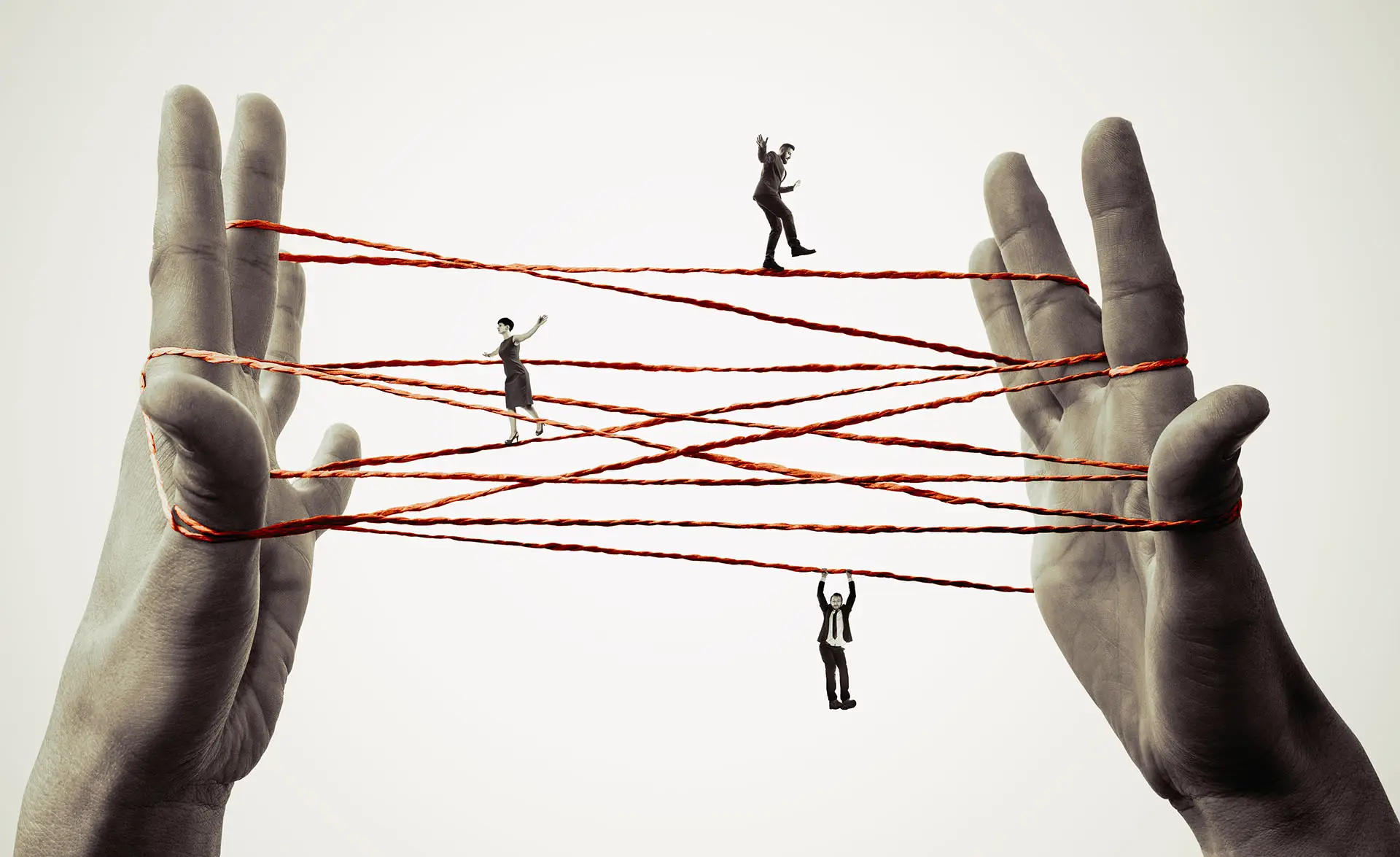
The Funnel Was Never As Linear As We Pretended
Marketing diagrams have always had a habit of making customer journeys look wonderfully tidy.
Real people rarely cooperate.
Customers have an annoying habit of behaving like people rather than flowcharts.
Even before social media, smartphones and AI, buying decisions were rarely as linear as many models suggested.
People pause their research.
They get distracted.
They revisit options weeks later.
They seek second opinions.
They compare multiple businesses simultaneously.
They change priorities.
They return to suppliers they originally dismissed.
The reality is that customer journeys have always been messy.
Modern technology has simply made that messiness more visible.
This idea sits at the heart of our Marketing Clarity series, which explores the principles behind visibility, trust, positioning and customer behaviour in modern marketing.
What Is A Multi-Touchpoint Customer Journey?
A multi-touchpoint customer journey is simply a buying journey that involves multiple interactions, platforms, conversations and sources of information before a decision is made.
Most customer journeys have always been multi-touchpoint to some degree.
What has changed is the number of touchpoints involved and the number that now occur outside a business’s visibility.
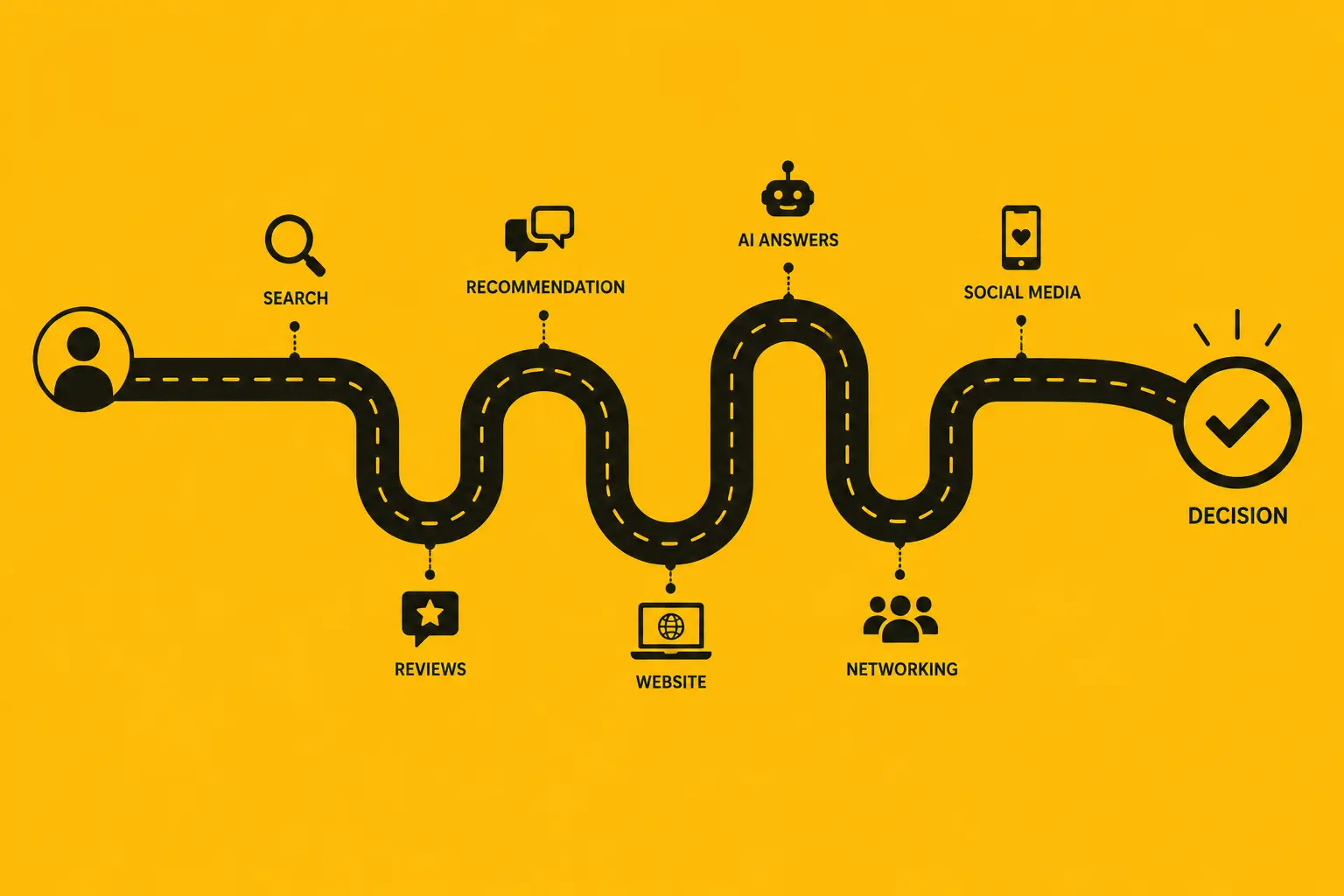
A customer may discover a business through a search engine, read reviews, ask for recommendations, encounter social content, visit the website, see an AI-generated summary and speak to existing customers before ever making contact.
The journey is no longer a straight line.
It is a network of interactions that collectively help someone move towards a decision.
Imagine someone looking for a new accountant.
They ask a business owner they trust.
Read Google reviews.
Visit several websites.
Ask ChatGPT.
See a LinkedIn post.
Attend a networking event.
Receive another recommendation.
Then finally submit an enquiry.
The accountant sees one enquiry.
The customer experienced dozens of touchpoints.
The Journey Is Now Spread Across More Touchpoints Than Ever
A customer researching a business today may encounter it through a surprisingly wide range of online and offline interactions.
Some are visible.
Many are not.
Some involve direct interactions with the business itself.
Others involve recommendations, reviews, conversations and third-party sources that take place entirely outside the business’s visibility.
For example:
- Search engines
- AI-generated answers
- Company websites
- Review platforms
- Industry directories
- Comparison websites
- YouTube
- Podcasts
- Industry publications
- Trade associations
- Awards and accreditations
- Supplier directories
- Online communities
- Industry forums
- Reddit discussions
- Professional networks
- WhatsApp groups
- Team meetings
- Internal recommendations
- Word-of-mouth referrals
- Networking events
- Conferences
- Exhibitions
- Existing customers
- Former customers
- Colleagues
- Friends and family
The journey still exists.
It simply happens across far more locations than it once did.
Customers move fluidly between platforms, devices and conversations.
The buying process may start in one place, continue somewhere entirely different and conclude weeks later through a channel the business never anticipated.
The journey is no longer contained within a handful of measurable interactions.

Businesses Are Often Seeing Only Part Of The Journey
This is where many organisations become frustrated.
Marketing appears to be underperforming.
Lead generation seems inconsistent.
Attribution becomes increasingly difficult.
Businesses naturally assume something is broken.
Often, the reality is much simpler.
They are only seeing part of the journey.
A prospect may already have:
- Seen multiple social media posts
- Read online reviews
- Encountered AI-generated summaries
- Visited the website several times
- Searched for the company name repeatedly
- Viewed LinkedIn content
- Watched videos
- Spoken to colleagues
- Requested recommendations
- Compared alternatives
All before submitting a single enquiry.
The business experiences the enquiry as the beginning of the relationship.
For the customer, it may be one of the final stages.
Judging an entire customer journey from a single enquiry is a little like trying to understand a room by looking through a keyhole.
You can see something.
You may even see something important.
But there is far more happening beyond the narrow field of view available to you.
The challenge is not that the room is complicated.
The challenge is that you cannot see all of it at once.
Most of us have experienced this ourselves.
We search for a company, read a few reviews, visit a website, get distracted, ask someone for an opinion, see the business mentioned again weeks later and only then decide to make contact.
Yet from the business’s perspective, the enquiry can appear to arrive out of nowhere.
Why Is Attribution Becoming More Difficult?
Attribution is simply the process of identifying which activities, interactions or channels influenced a customer to enquire or make a purchase.
Historically this was challenging but often manageable.
Today it is becoming increasingly difficult.
The more touchpoints involved in a customer journey, the harder it becomes to identify which interaction mattered most.
Was it the review?
The recommendation?
The LinkedIn post?
The website visit?
The AI-generated answer?
The networking conversation?
Often the honest answer is that all of them contributed in some way.
Businesses naturally want clear answers.
Modern customer journeys rarely provide them.
The further a journey spreads across multiple touchpoints, the less likely a single channel deserves all the credit.
The First Touchpoint Isn’t Always The First Touchpoint
One of the most common mistakes businesses make is assuming the first interaction they see is the first interaction that happened.
It often isn’t.
The first website visit that appears in analytics may be the fifth time someone has encountered the brand.
The first enquiry form may arrive after weeks of research.
The first sales conversation may follow dozens of invisible interactions.
By the time many customers make contact, they have already formed impressions, built confidence and reduced uncertainty.
The challenge is that much of this process happens outside the visibility of traditional reporting tools.
Businesses frequently mistake the first touchpoint they can measure for the first touchpoint that occurred.
The two are rarely the same thing.
Some Of The Most Important Research Is Invisible
Businesses naturally focus on the interactions they can measure.
Website visits.
Clicks.
Conversions.
Enquiries.
Sales.
Yet many of the interactions that influence decisions leave little or no measurable trace.
A prospect might:
- Ask for recommendations in a private Facebook group
- Seek advice within a WhatsApp community
- Discuss suppliers during a team meeting
- Receive a recommendation from a colleague
- Read an AI-generated summary
- Watch a video without clicking through
- Save content for future reference
Each interaction may influence the eventual decision.
None may appear within a marketing dashboard.
Businesses often mistake reduced visibility for reduced customer activity.
They are not the same thing.
The customer journey has not become less active.
It has become harder to see.
The Problem Isn’t Customer Behaviour. It’s Visibility
Businesses often conclude that customer behaviour has become unpredictable.
In reality, customer behaviour remains surprisingly consistent.
People still seek reassurance.
They still compare options.
They still ask for recommendations.
They still look for evidence before committing.
What has changed is visibility.
Businesses are often trying to understand a journey when they can only see selected parts of it.
Unfortunately, visibility and understanding are not the same thing.
Seeing part of a journey does not necessarily mean understanding the journey.
The challenge is not understanding customer behaviour.
The challenge is understanding what happens beyond the areas that can be measured.

Why Brand Familiarity Matters More Than Ever
When customer journeys become fragmented, familiarity becomes increasingly important.
People rarely choose a business because of a single interaction.
Trust tends to develop gradually.
Repeated exposure creates:
- Familiarity
- Recognition
- Confidence
- Reassurance
The more often people encounter a consistent message, the easier it becomes to understand what a business does and why it matters.
Brand familiarity does not guarantee enquiries.
But it often increases the likelihood that a business is considered when a decision needs to be made.
In many cases, the business that feels familiar feels safer.
And safer often feels easier to choose.
Communication Friction Becomes More Dangerous
As customer journeys spread across more touchpoints, communication becomes increasingly important.
Every interaction either reinforces understanding or creates confusion.
A customer may encounter:
- One message on the website
- Another on LinkedIn
- Something different on social media
- Different wording in reviews
- Alternative descriptions in AI-generated answers
When messages vary significantly, confusion increases.
When understanding becomes harder, trust often becomes harder to build.
This is communication friction in action.
The more fragmented the customer journey becomes, the more costly inconsistency becomes.
Businesses often assume that more channels require more content.
In reality, they often require greater clarity.
This is where clarity and consistency become increasingly important.
The more touchpoints a customer encounters, the more opportunities there are either to reinforce understanding or create confusion.
AI Is Becoming Part Of The Journey
AI is increasingly becoming another stop along the customer journey.
Not the journey itself.
Simply one of many touchpoints customers may encounter.
A potential customer may move between:
- Search results
- AI-generated answers
- Review platforms
- Company websites
- Social media content
All within the same research process.
AI is not replacing customer journeys.
It is becoming part of them.
Like search engines, review sites and social platforms before it, AI is simply another place where people gather information and seek reassurance. This is one reason why conversations around AEO (Answer Engine Optimisation) have become increasingly common.
What Businesses Should Focus On Instead
Attempting to track every interaction is becoming increasingly difficult.
In many cases, impossible.
Rather than chasing perfect attribution, businesses may be better served focusing on the factors that strengthen every stage of the customer journey.
These include:
- Clarity
- Consistency
- Trust
- Familiarity
- Credibility
- Recognisable positioning
- Reduced communication friction
These elements help customers regardless of where they encounter a business.
Whether someone discovers a company through a search engine, an AI answer, a recommendation or a social media post, the same principles apply.
Make it easy to understand.
Make it easy to trust.
Make it easy to remember.
Questions Businesses Should Ask Themselves
Rather than asking how to track every customer interaction, better questions might include:
- How many places might customers encounter us before enquiring?
- Are we consistently described across those places?
- Are we easy to understand quickly?
- Would different touchpoints reinforce the same message?
- Are we making trust easier to build or harder?
- Are we reducing uncertainty or creating it?
- Are we measuring the whole journey or only the parts we can see?
The answers often reveal more than another analytics report.
In Summary
- Customer journeys still exist.
- Customer intent has not fundamentally changed.
- Research behaviour remains remarkably familiar.
- Most research is ultimately about reducing risk.
- Customer journeys now span more touchpoints than ever before.
- Businesses often see only part of the journey.
- Visibility and understanding are not the same thing.
- Attribution is becoming more difficult.
- Clarity, consistency and trust matter more than ever.
The Last Word
The customer journey has not become random.
Customers have not become unpredictable.
They are still researching, comparing, validating and reducing risk in remarkably familiar ways.
What has changed is the number of places where those activities occur and the amount of visibility businesses have into them.
Businesses that continue to view customer journeys through a ten-year-old lens may find themselves measuring only part of the picture.
The problem is not that customer journeys have become harder to understand.
It is that they have become harder to observe.
The journey still exists.
It is simply taking place across more touchpoints, more platforms and more conversations than ever before.
Businesses that understand this shift can stop chasing perfect attribution and start focusing on something far more valuable:
Being consistently visible.
Consistently understandable.
And consistently trustworthy wherever customers encounter them.
Part of the Marketing Clarity Series
This article is part of the Marketing Clarity series from The Last Hurdle, exploring the principles behind marketing that works.
Many businesses believe customer behaviour has become unpredictable. In reality, customers are often behaving in remarkably familiar ways. What has changed is where those interactions happen and how visible they are to businesses.
The Marketing Clarity series explores the concepts behind visibility, trust, communication, positioning and customer behaviour, helping businesses better understand how modern marketing really works.