

Are You Sure You Know Who You’re Marketing To?
What if the thing holding back your growth isn’t your offer, your budget, or your SEO, but a misunderstanding of who you’re actually selling to?
Be honest.
When was the last time you properly questioned who your target market is?
Not the version written in your original business plan.
Not the one you repeat at networking events.
The real, commercially relevant one, today.
Because “SMEs” is not a market.
“Homeowners” is not a market.
“Commercial clients” is not a market.
Those are umbrellas.
And umbrellas hide detail.
What Is Target Market Strategy?
Target market strategy is the process of identifying not just who your audience is, but how they think, decide and buy. It aligns marketing, sales and delivery around real buying behaviour, improving conversion, client fit and long-term growth.
The Quiet Drift That Costs You
Here’s what happens.
You win a few good clients.
You decide, “Yes, that’s our audience.”
You build messaging around them.
Then the market shifts.
Budgets tighten.
Decision-makers change.
Risk tolerance moves.
Growth slows, or accelerates.
But your understanding stays the same.
You’re still marketing to the 2021 version of your buyer.
Meanwhile, they’ve evolved.
That gap?
That’s where performance quietly starts slipping.
Leads feel “off.”
Campaigns feel harder.
Conversion slows.
Price objections increase.
It’s rarely a creativity problem.
It’s an understanding problem.
And in a 10–30 person business, that misunderstanding doesn’t just affect marketing performance.
It affects margin.
It affects team capacity.
It affects delivery pressure.
It affects how predictable your pipeline really is.
When the wrong buyers enter the system, the strain shows up everywhere.
Let’s Have the Conversation Properly
Imagine your ideal client sitting across from you.
You ask:
“What’s driving your decisions this year?”
Do they say:
“We need to reduce risk.”
“We need to justify every spend.”
“We’re under pressure to grow.”
“We want to position ourselves as more premium.”
Those answers are not interchangeable.
If someone is trying to avoid failure, your marketing must feel structured and safe.
If someone is trying to achieve growth, your marketing must feel ambitious and forward-moving.
If someone is trying to protect reputation, your marketing must reinforce credibility.
Same service.
Different psychology.
And psychology shapes purchasing decisions far more than demographics ever will.
Two companies of the same size, in the same industry, can buy for completely different reasons, one driven by fear of failure, the other by ambition for growth. If your marketing speaks to the wrong driver, it won’t land.
A Real-World Pattern
Over the years, we’ve noticed something consistent.
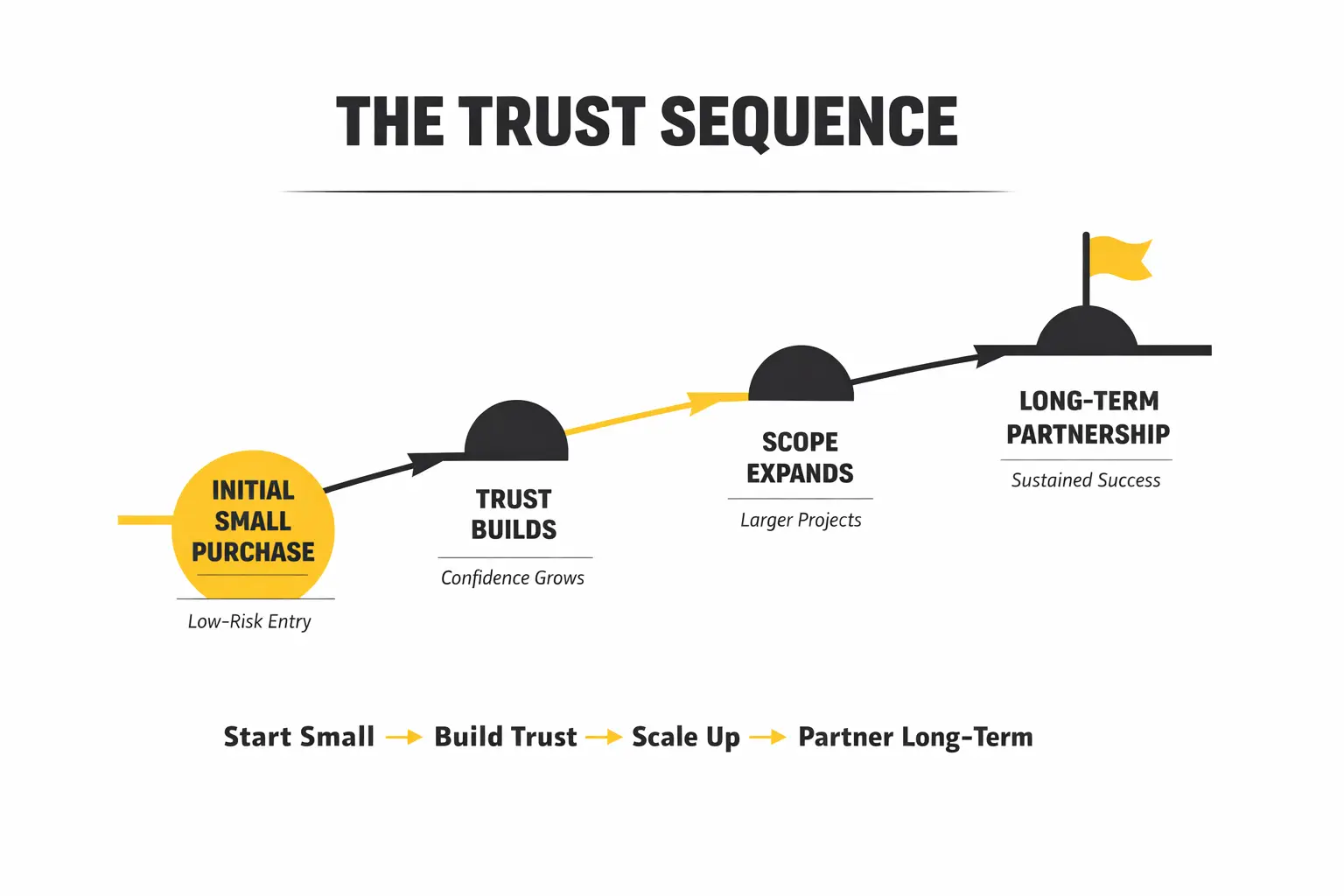
Our strongest, longest-standing clients rarely started with the biggest project.
They didn’t jump straight into a full marketing overhaul.
They started smaller.
A contained project.
A focused diagnostic.
A one-off consultancy session.
A clearly scoped first step.
Lower risk.
Clear boundaries.
Defined outcome.
Then, once they experienced how we think, how we communicate and how we deliver, they scaled.
Not because they were pushed.
Because trust had formed.
Occasionally, the opposite happens.
A large, urgent rescue project arrives first.
High stress.
High expectation.
Low existing trust.
And that relationship often feels harder from the outset.
More resistance.
More friction.
More questioning.
Same capability.
Different starting point.
That contrast isn’t accidental.
It’s behavioural.
Cold enquiries arrive without built-in trust.
They arrive cautious.
Even if the need is significant.
Even if the budget exists.
Even if the long-term scope is obvious.
Understanding that trust has a sequence is what separates reactive marketing from structured strategy.
This is where strategic marketing becomes commercial intelligence.
Map the Decision Process (And the Buying Pattern)
How do your best clients actually buy?
Do they compare multiple quotes?
Need internal sign-off?
Rely on recommendations?
Research heavily before engaging?
But go deeper.
What did they buy first from you?
Not what they buy now.
What did they buy when trust was still forming?
Did they:
Start with a small audit?
Test you with a contained project?
Purchase a lower-risk entry service?
Trial before committing?
Or did they go straight to a premium commitment?
This isn’t just interesting.
It’s strategic intelligence.
If your strongest clients consistently start small and then scale, that’s not a weakness.
It’s a repeatable pattern.
You don’t need to force the biggest sale upfront.
You need to design the right entry point.
Low-risk first step → Trust builds → Value demonstrated → Scope expands.
That’s not “selling small.”
That’s architecting growth.
Buying behaviour leaves patterns.
Patterns reveal leverage.
And leverage is where growth becomes deliberate instead of accidental.
If you can see how your best clients move from first engagement to long-term partnership, that pathway can be refined, protected and repeated.
That’s not a marketing tactic.
That’s commercial design.
Most businesses only realise this when delivery starts to feel heavier than it should.
The Hidden Cost of Attracting the Wrong Buyer
When market understanding is shallow, something subtle happens.
You start attracting people who look right on paper…
But feel wrong in reality.
They question every recommendation.
They push on price constantly.
They expect flexibility where you need structure.
They don’t value the expertise the way your best clients do.
That’s rarely “a bad client.”
It’s usually misaligned positioning.
Marketing shapes expectations long before a sales conversation ever happens.
And expectation shapes behaviour, often subconsciously.
If your messaging emphasises “affordable,” you attract price sensitivity.
If it emphasises authority and structure, you attract decisiveness.
Those signals matter.
Alignment improves fit.
Better fit improves profitability, morale and long-term stability.
It also improves delivery efficiency.
Fewer reactive conversations.
Fewer boundary disputes.
Fewer pricing battles.
Alignment reduces operational friction and that has measurable impact.
This Isn’t Just Marketing’s Job
Understanding your market cannot sit in one department.
If marketing understands the buyer but sales doesn’t, conversations disconnect.
If sales understands but operations doesn’t, delivery disappoints.
If customer service doesn’t understand what matters most to that buyer, loyalty erodes.
Everyone in the organisation should be able to answer:
“Why does our ideal client choose us?”
Without hesitation.
Because cohesion builds credibility.
And credibility builds trust.
If you want this to be more than theory, here’s how to apply it.

How to Reanalyse Your Market Properly
Not a brainstorm.
A structured review.
Analyse your strongest clients, not just your biggest.
Identify their core buying driver: avoid, protect, achieve, improve or elevate.
Map how they buy and what they buy first.
Separate distinct audiences instead of blending them.
Share those insights internally so alignment becomes cultural, not accidental.
Markets evolve.
Your understanding should too.
Target market strategy is not a one-time exercise.
It should be reviewed with the same seriousness as financial forecasting or operational planning, because it directly influences both.
Why Understanding Your Target Market Matters
Understanding your target market isn’t about niche labels or surface-level segmentation.
It’s about aligning your marketing strategy with real buying behaviour.
When marketing reflects how your ideal clients actually think and decide, conversion improves, sales conversations shorten and growth becomes more predictable.
Misalignment, on the other hand, creates friction and friction costs time and money.
A Final Question
If you mapped your last 10 clients, would you see a pattern?
How they found you
What they bought first
How long they took to decide
What triggered the initial enquiry
When and why they scaled
Most businesses don’t analyse this.
And yet, it’s one of the clearest indicators of where growth really comes from.
Understanding that pattern is often the difference between reactive marketing and structured strategy.
The Last Word
If your marketing feels harder than it should…
Pause.
Before increasing budget.
Before rewriting your website.
Before blaming the algorithm.
Ask:
“Do we genuinely understand who we are marketing to and why and what they buy?”
At The Last Hurdle, we don’t believe in pushing the biggest solution first or applying the same campaign to every audience.
We believe in structured strategy.
Sometimes that means stepping back and analysing before amplifying, because growth built on clarity is far more sustainable than growth built on assumption.
In stepping back before stepping forward.
In analysing before amplifying.
In understanding real buying behaviour.
In identifying repeatable patterns.
In designing the right entry point.
In building trust deliberately and scaling intelligently.
Because when strategy is built around reality, not assumption, marketing becomes clearer.
Conversations become calmer.
Growth becomes more predictable.
Clarity first.
Everything else follows.
Part of the Marketing Clarity Series
This article is part of the Marketing Clarity series from The Last Hurdle, exploring the principles behind marketing that works.