

Your Content Hub May Already Exist
Content hubs have become one of those things that almost every marketer seems evangelical about. I can see why. Bringing related content together can help people understand a subject and find the answers they need.
But there is a gap in much of the advice about them.
Yes, I know. I talk about gaps so often that I am considering changing my job title to Gap Exposer Extraordinaire. Perhaps not. Still, this one does matter.
Much of the advice I see starts with “create a content hub” and then asks what you are going to put in it. For many businesses, much of the content is already there. It has been written at different times, for different reasons and across different channels. What is missing is a clear view of how those pieces connect, what subject they are helping people understand and which answers are still missing.
Before you plan another batch of articles, look at what your business has already been explaining. You may already have the foundations of a useful content hub. Recognising them can help you make better use of that work and decide what deserves your attention next.
What is a content hub?
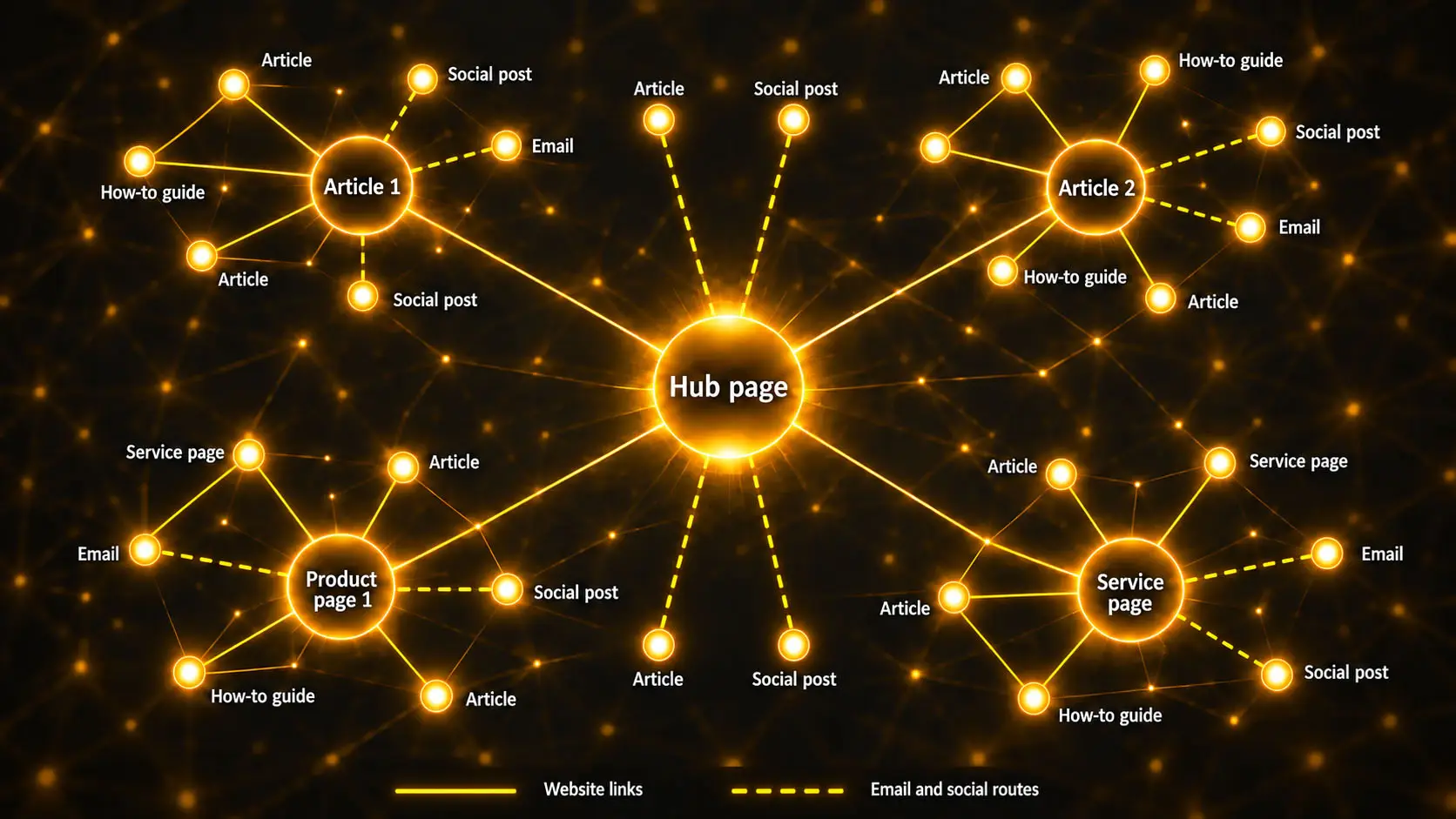
A content hub is a collection of related articles, guides and resources organised around one subject, with a central page and relevant links helping people find the answers they need.
The central page introduces the subject and directs readers towards more detailed information. Those pieces also link to one another where there is a useful connection.
Think about someone reading an article that helps them recognise a problem in their business. Their next question might be why it happens, what they can do about it or whether they need professional help. A useful hub makes those answers easier to find.
To create that structure, you need to understand how the questions connect. That is where reviewing your existing content becomes valuable.
How our own content hub took shape
At The Last Hurdle, we were writing about questions that kept coming up in our work.
Why does a website attract visitors but generate few enquiries? What helps someone trust a business they have never dealt with? Is being found online the same as being chosen? Why does increasing marketing activity sometimes achieve very little?
Each article addressed its own question. As the collection grew, we recognised that they were also exploring different parts of a bigger subject: what actually makes marketing work?
Marketing Clarity became the way to bring that thinking together.
Articles about messaging, trust, customer journeys, search and performance had connections that were useful to the reader. Someone trying to understand why their website was not generating enquiries might need to consider several of those subjects.
Giving the collection a structure made those connections easier to see. It also helped us identify where we had explained one part of a problem but left the next question unanswered.

Find the subject connecting your content
Start with something your customers regularly ask about.
Then look at where your business already discusses it. That might include service pages, blog articles, emails, social posts, guides or explanations your team gives in conversations.
What are those pieces helping someone understand? Are they addressing different parts of the same problem or decision?
The connection needs to be useful to your audience. “These are all services we offer” gives you a list, but it may offer very little help to someone trying to work out what they need.
A stronger connection might be the questions customers ask before choosing a particular service. You may already explain the signs that they need it, the options available, what the work involves and what affects the cost. Together, those answers could help someone make a more informed decision.
Choose a subject that matters to your customers and that your business has the experience to explain properly. It should also relate to the work you want to be known for.
Map the answers you already have
You do not need to begin with an elaborate spreadsheet. Choose one subject and gather the relevant content.
For each piece, record:
- Where it lives, such as a website page, email or social post.
- Which question it answers.
- What someone is likely to ask next.
- Which existing piece answers that next question, or whether an answer is missing.
An email or customer conversation may contain an explanation worth developing into a website resource. It does not necessarily need to appear in the hub in its original form.
Looking at the answers together makes the gaps clearer.
You might have a detailed service page explaining what you do, but very little to help someone recognise when they need that service. You might have three articles answering closely related questions, with no links between them. Or you might discuss a subject regularly on social media but have nowhere to send someone who wants a fuller explanation.
Each situation needs a different response.
The service page may need an additional explanation. The articles may need relevant links and clearer signposting. The social content may reveal a question worth exploring in a new article.
Check for repetition and whether the advice still reflects your business. There is little value in directing more people towards advice that is outdated or no longer reflects what you offer.
What this could look like in practice
Imagine a blinds business reviewing its content. It already has a page about its bedroom blinds service, an article explaining blackout blinds and a guide to measuring windows. Its team also regularly answers questions about child safety.
Those pieces could contribute to a hub about choosing bedroom blinds.
The blackout article helps someone consider light control. The measuring guide helps them understand how to get the right fit. Reviewing customer questions reveals that child safety deserves a clear explanation of its own.
A central page could introduce the main considerations and direct readers towards each answer. The supporting articles could link to related guidance where it helps, and the service page could explain the business’s advice, measuring and fitting options.
The business now has a purpose for a new child safety article and a way to make its existing content easier to use. It can also see which other questions remain unanswered.
Give readers a way through it
Your content map shows you the connections. The website needs to make those connections visible to the reader.
A central hub page can explain the subject, introduce its main themes and suggest useful starting points. Individual articles can explore specific questions in more depth. Relevant service pages can explain how your business helps when someone reaches that stage in their decision.
Existing articles can stay where they are; the hub page and relevant links give readers a way to find them.
For our Marketing Clarity hub, we have grouped articles around themes such as understanding your audience, removing doubt and building trust, clear messaging, and being found versus being chosen. We also suggest starting points based on the problem someone is trying to solve.
Some articles belong to more than one theme because the questions overlap. Organise the content around how customers understand the problem. They should not need to understand your internal categories to find an answer.
Remember that someone may never visit the central page. They might arrive directly at an article through search, an email or a social post.
That article needs to answer its own question properly and offer a sensible route to further information.
For the blinds business, someone reading about blackout blinds might next need help measuring their windows. A link labelled “How to measure your bedroom windows” tells them what guidance they will find.
That gives someone a reason to follow the link and a clear expectation of how the next piece will help.
Carry the subject across your marketing
The website gives people somewhere to explore a subject in depth. Emails and social posts can introduce ideas, answer smaller questions or bring a timely issue to their attention.
For the blinds business, an email might introduce the bedroom blinds guide to existing customers. Social posts could answer individual questions about light control or measuring, with a link to fuller guidance where appropriate.
Each piece has its own job, but all draw on the same understanding of the subject.
A question raised in a customer conversation might become an article. A useful point within that article might become a social post. An email might introduce the subject to people who would benefit from the fuller explanation.
This gives you a more coherent way to plan your marketing. The work on one channel can inform the work on another, with the content adapted to suit the people encountering it there.

A framework to help you develop your topic
A useful resource to help develop your content hub is Semrush’s Topical Gravity framework. If reviewing your content reveals several possible subjects, it can help you decide where to focus and what to develop.
Its Define stage considers where customer questions, your expertise and commercial relevance overlap. Its Build stage encourages you to explore the related questions, comparisons, practical uses and buying information people need, including where they look for answers beyond your website.
You can use those first two stages to challenge your content map. Does the subject matter to your customers and your business? Have you answered enough of their questions to help them make an informed decision? That review can help you identify where further work would be useful.
The framework then moves into Measure and Expand. Measure looks at how visible your business is across the subject, including how that presence compares with competitors. Expand considers which closely related topics to develop once you have established a strong presence in your original subject.
Those stages take the work beyond creating and organising the hub. They help you review where you are gaining ground and decide what to develop next. We will explore measurement further in our next article, including how to assess whether your content hub is helping your audience and your business.
The Last Word
If your business has been creating content for a while, choose one subject you regularly discuss and look at it as a whole.
Gather the relevant pieces. Identify the questions they answer. Consider what a reader would need next and whether you have made that answer easy to find.
You may discover that you already have enough material to create a useful hub. You may find that a few improvements would make the existing content much more helpful.
Either way, you will have a clearer view of what your content already helps people understand, what needs improving and where an answer is missing. That gives your next piece of content a clear purpose and a place within the work you have already done.
Part of the Marketing Clarity Series
This article is part of the Marketing Clarity series from The Last Hurdle, exploring the thinking behind clearer, more effective marketing.
From connecting existing content to answering customer questions and making the next step easier to find, the series considers how your marketing helps people understand your business and make informed decisions. It also explores how to assess whether that work is contributing to what your business is trying to achieve.